69% of Singles Say a Man Needs ₹25 Lakh a Year to Be Marriage-Ready. Only 48% of the Married Agree
Half also say the bride's side still pays, in cash, gold, or the wedding itself
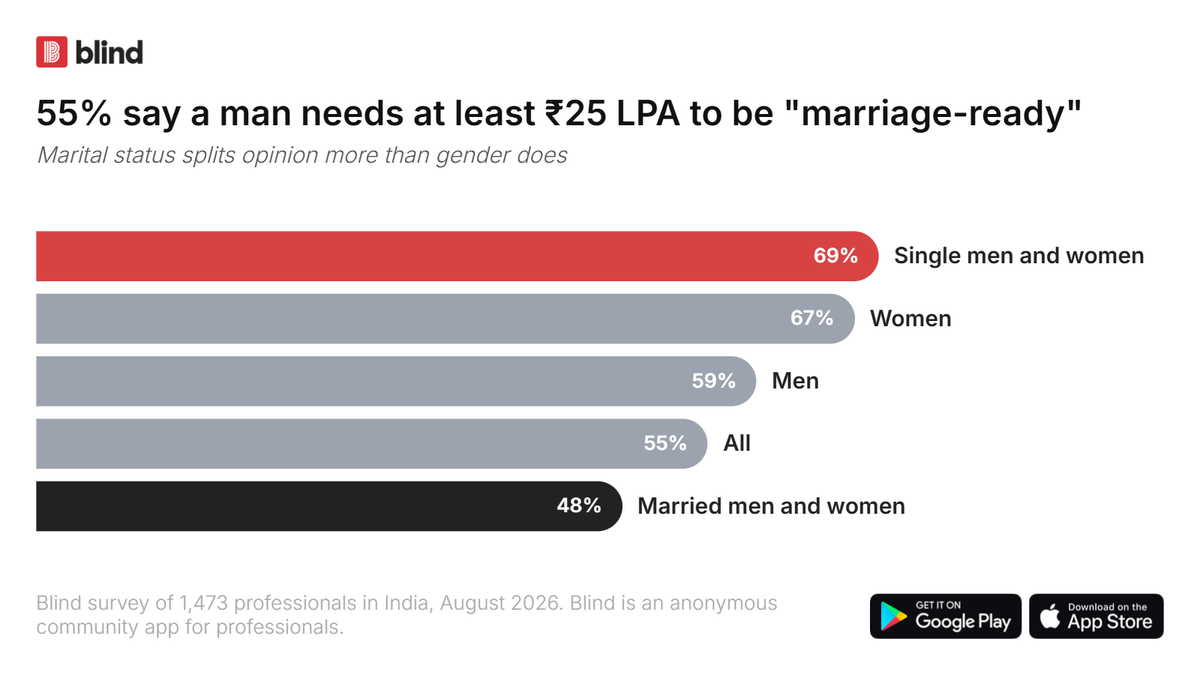
India's tech workers have put a price tag on a “marriage-ready” man, and singles set it much higher than married people do. In a survey of 1,473 India-based professionals by Blind, the anonymous community app for verified employees, 69% of unmarried respondents say a man needs to earn at least ₹25 lakh per annum (LPA) before he is ready for marriage. Among married respondents, only 48% agree. Married respondents are also nearly twice as likely to say income shouldn't matter at all (21% versus 12%).
Gender turns out to matter less than marital status. 67% of women set the bar at ₹25 LPA or more, against 59% of men. That gap is roughly a third the size of the one between the unmarried and the married.
Overall, 55% set the minimum at ₹25 LPA or higher, while nearly 3 in 10 (29%) put it above ₹50 LPA. These expectations come from a relatively affluent group: 78% of respondents work at global tech companies. Even so, ₹25 LPA is more than double the salary of the average software engineer in India according to Indeed, while ₹50 LPA is a level reached by just over 1% of taxpayers based on income tax return filings. Yet even within this group, married respondents are less likely to view such incomes as a prerequisite, suggesting that expectations of singles are higher than what most people can realistically earn.
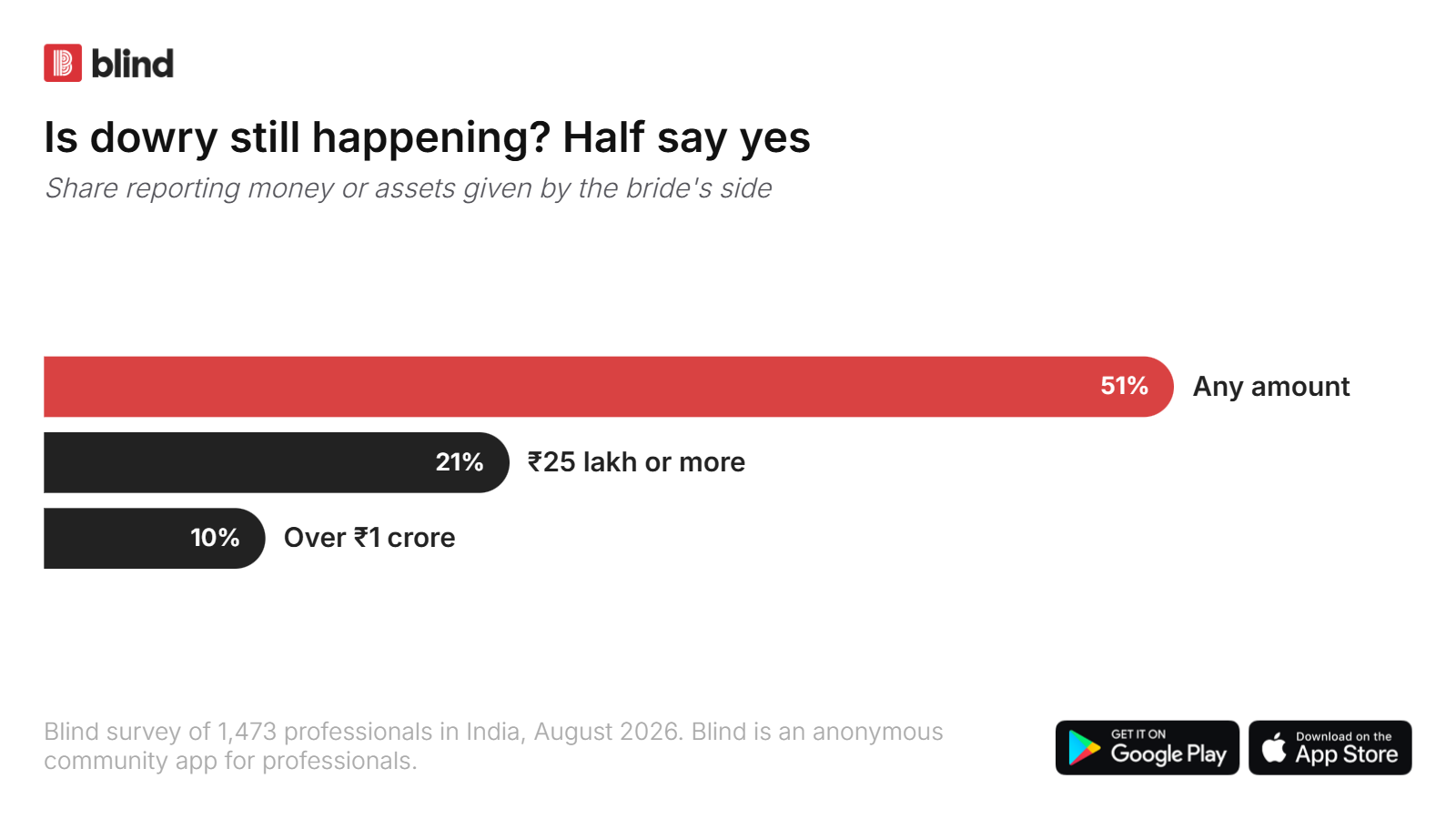
Financial expectations may not stop at salary. Asked whether money or assets, like cash, gold, vehicles, property, or wedding costs, were given by the bride's side in their own marriage or one close to them, 51% said yes. One in five (21%) put the value at ₹25 lakh or more, and 10% at over ₹1 crore. Dowry has been illegal under the Dowry Prohibition Act of 1961.
Women report it far more often than men. 67% of women report money or assets changing hands, compared with 50% of men. Some of the gap may be in what gets counted. Often nothing is asked for outright, but the groom's side may read an expensive wedding as a deserved status symbol of his salary or property, while the bride's side, paying for it, sees a dowry by another name. The expectation is priced without anyone having to say it out loud.
That implicit exchange shows up in conversations about dowry on Blind. On this thread, "how much dowry did you get?", men described money that arrived without anyone asking for it. A user at Amazon described a transfer that "came a few years later and unasked for," and an ex-Meta user who refused outright said "later my in-laws handed over a few lakh to my wife behind my back to help her set up her house. I was informed much later."
Methodology
Blind surveyed 1,473 India-based professionals between August 4 and August 11, 2026, on financial expectations around marriage. Demographic breakdowns exclude the 20% who preferred not to state gender or marital status, so they will not match the overall figures. Response breakdowns are as follows:
- What minimum annual salary does a man need to be considered "marriage-ready"?
- Under ₹10 LPA (3%)
- ₹10 – ₹15 LPA (7%)
- ₹15 – ₹25 LPA (16%)
- ₹25 – ₹50 LPA (26%)
- Over ₹50 LPA (29%)
- Income shouldn't matter (19%)
- In your own marriage, or those of someone close to you, were money or assets (cash, gold, vehicle, property, or wedding costs) given by the bride's side part of the arrangement? If so, roughly what was the total value?
- Yes, under ₹10 lakh (15%)
- Yes, ₹10 to ₹25 lakh (15%)
- Yes, ₹25 lakh to ₹1 crore (11%)
- Yes, over ₹1 crore (10%)
- No, never (49%)
- Which best describes you?
- Married man (33%)
- Unmarried man (34%)
- Married woman (5%)
- Unmarried woman (8%)
- Prefer not to say (20%)