A Blow to Big Tech: 50% of Meta Staff Snub Their Own AI in Favor of Claude
Despite heavy internal pressure to use company-built AI tools, professionals are quietly choosing something else, and it’s not what their employers want.
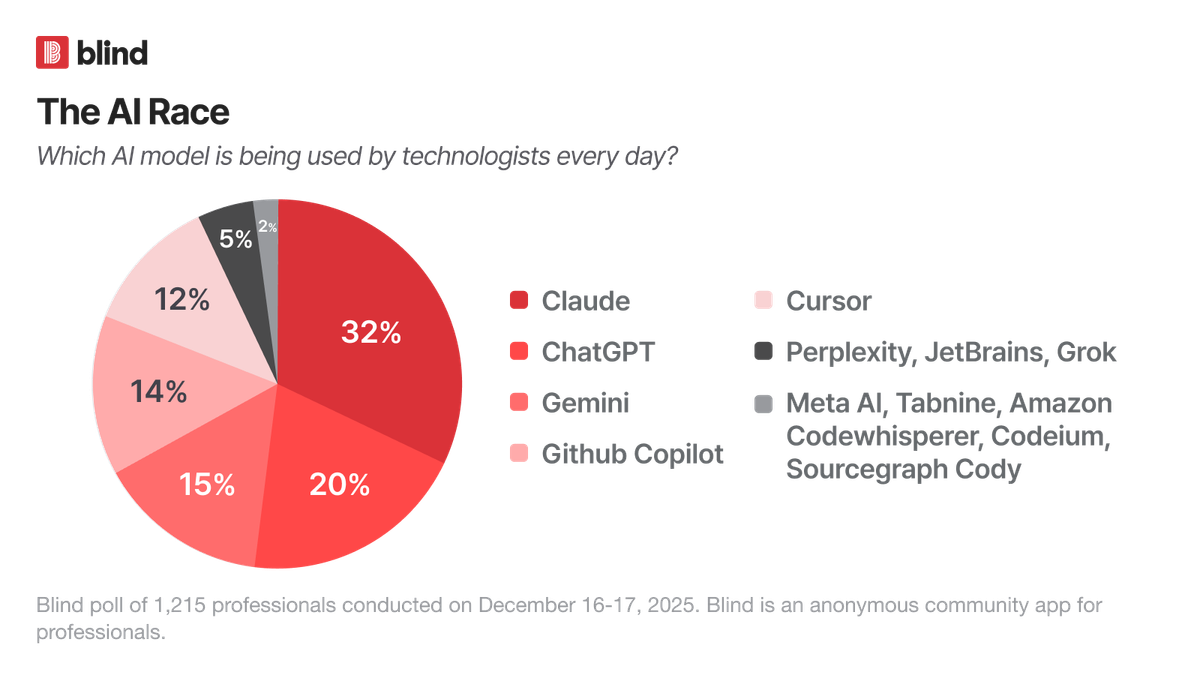
According to a Blind survey of 1,215 professionals conducted December 16-17, 2025, 31.7% of respondents say Claude is their go-to AI model at work, making it the most-used model overall. ChatGPT trails behind at 19.6%, followed by Gemini (15%), GitHub Copilot (14.2%), and Cursor (11.5%).
Most respondents are software engineers using AI for code generation, debugging, and system design—areas where Claude appears to be winning trust. The most uncomfortable point for Big Tech? Employees are actively bypassing their own company’s AI.
Nowhere is the rejection more visible than Meta.
One user on Blind, verified as a Meta employee, shared, "Meta AI is worse than the Metaverse. I've seen more motivated and hardworking people in the Metaverse. But the AI team is filled with arrogant and selfish folks. We had to make Meta the second most popular chatbot by the end of 2025. Instead of providing something impactful, we faked the metrics by cheating and double counting. Image generation is the only space we are doing decently, but just burning money in data centers."
50.7% of Meta employees report Claude as their primary AI tool. Just 8.2% use Meta AI. For a company betting its future on AI, the message from inside its own walls is blunt: engineers don’t trust what leadership is pushing.
Microsoft isn’t far behind. Despite Copilot being deeply embedded across the company, Claude edges it out (34.8% vs. 32.2%), with ChatGPT trailing at 18.3%.
Google is the lone exception: 57.6% of Google employees report using Gemini, but that dominance doesn’t extend beyond Google’s walls. Only 11.6% of Amazon employees say Gemini is their top choice, and Amazon CodeWhisperer/Q barely registers in the broader rankings.
Blind users report using multiple AI tools depending on the task, but when it comes to writing real production code, Claude consistently wins. ChatGPT remains a fallback for lighter tasks, like document revisions and simpler problem-solving.
The takeaway is clear: mandates don’t create adoption. Even inside the companies building these tools, engineers are choosing the model that’s best adapted to support their style of work, not the one they’re told to use.
The question now isn’t which model is best, it’s whether these tech companies can stop losing its own engineers to tools it doesn’t own.
Methodology
Blind conducted a poll on its platform from December 16 to 17, 2025, collecting responses from 1,215 verified professionals based in the United States. The poll was composed of one multiple-choice question, allowing for more than one selection, designed to assess the respondents’ sentiment about different AI models and their usefulness in daily tasks.
Participants were asked the following:
- What kind of AI model are you using in day-to-day work?
- Github Copilot (14.2%)
- ChatGPT (19.6%)
- Claude (31.7%)
- Gemini (15.0%)
- Meta AI (0.6%)
- Cursor (11.5%)
- Amazon Codewhisperer (0.7%)
- Perplexity (2.8%)
- Codeium (0.5%)
- JetBrains (1.0%)
- Sourcegraph Cody (0.6%)
- Grok (1.8%)
- Tabnine (0.2%)
About Blind
Founded in Silicon Valley in 2013, Blind is a verified workplace community platform with the mission of “building sustainable workplace cultures through employee voices.” Over 80% of employees at Meta and Uber use the platform in the U.S., and it has been recognized by TIME as one of the 100 most influential companies in the world. Blind expanded into India earlier this year, where more than half of tech and finance professionals are active users.