Are tech employees heading for the FIRE route?
For years, tech offered a clear promise: stability, strong pay, and upward mobility. Now, with repeated layoffs, AI-driven restructuring, and rising burnout, many professionals are asking a new question:
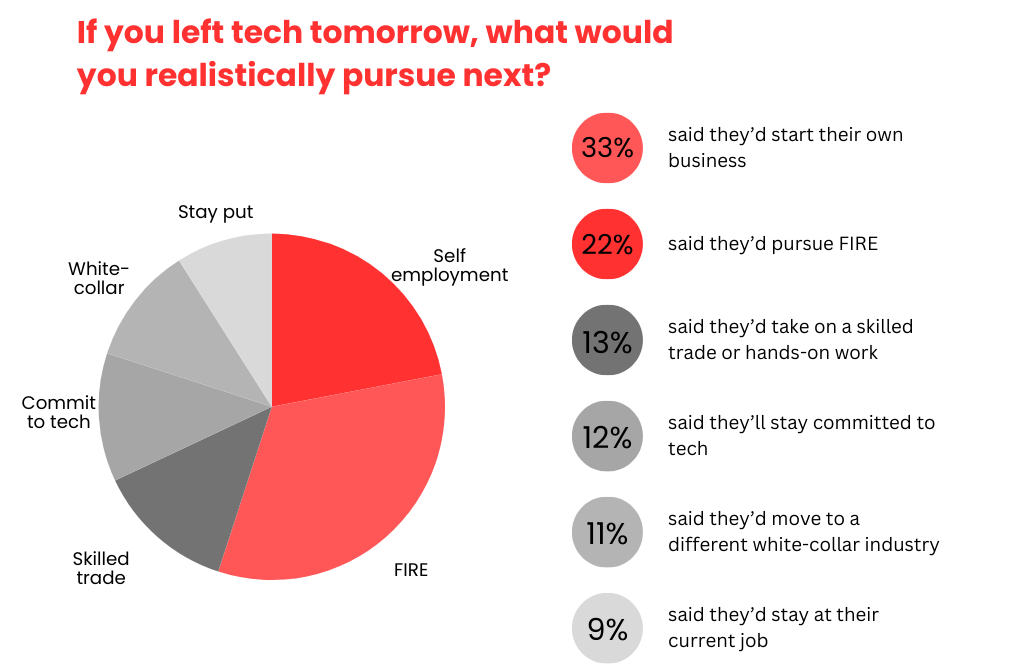
If you left tech tomorrow, what would you realistically pursue next?
This isn't about a dream job or a distant fantasy — it's about a practical, real-world pivot that could sustain income and long-term satisfaction.
Over the past year, turbulence across big tech and startups alike has made even high performers question whether the industry still offers the security it once did. As automation expands and teams shrink, career planning is shifting from “how do I get promoted?” to “what’s my exit plan?”
On Blind, this crossroads moment has become a recurring conversation. When asked what they would pursue if tech took a downturn:
- 22% said they’d pursue FIRE — Financial Independence, Retire Early — aiming to step away from traditional employment altogether.
- 33% said they’d start their own business, seeking control, flexibility, and purpose outside corporate tech.
- 13% said they’d take on a skilled trade or hands-on work, opting for an option that provides more creativity on a day-to-day basis, like art curation.
- 12% said they’ll stay committed to tech but likely step away from big tech.
- 11% said they’d move to a different white-collar industry, such as healthcare or finance.
- 9% said they’d stay at their current job, viewing switching as too risky.
The message is clear: far more workers are planning exits or pivots than doubling down on tech.
FIRE, once a niche ambition, is increasingly seen as a way to escape relentless performance pressure — and avoid re-entering a job market being reshaped by AI. Entrepreneurship and skilled trades reflect a similar drive toward autonomy and tangible control over one’s livelihood.
As one Blind user put it:
“Starting my own business from scratch never would have happened. But choosing a franchise with a proven template and support made it feel doable.”
Tech once promised long-term career certainty. Now, many of its workers are building parallel plans — or planning their departure entirely.
About Blind
Founded in Silicon Valley in 2013, Blind is a verified workplace community platform with the mission of “building sustainable workplace cultures through employee voices.” Over 80% of employees at Meta and Uber use the platform in the U.S., and it has been recognized by TIME as one of the 100 most influential companies in the world. Blind expanded into India earlier this year, where more than half of tech and finance professionals are active users.