Big Tech to Offshore More Jobs to India in 2026 as U.S. Mass Layoffs Continue
According to a new survey by Blind, more than half of professionals surveyed said their companies plan to increase hiring in India in 2026, signaling an acceleration of offshoring by major global tech firms including Google, Amazon, Microsoft, Uber, and eBay.
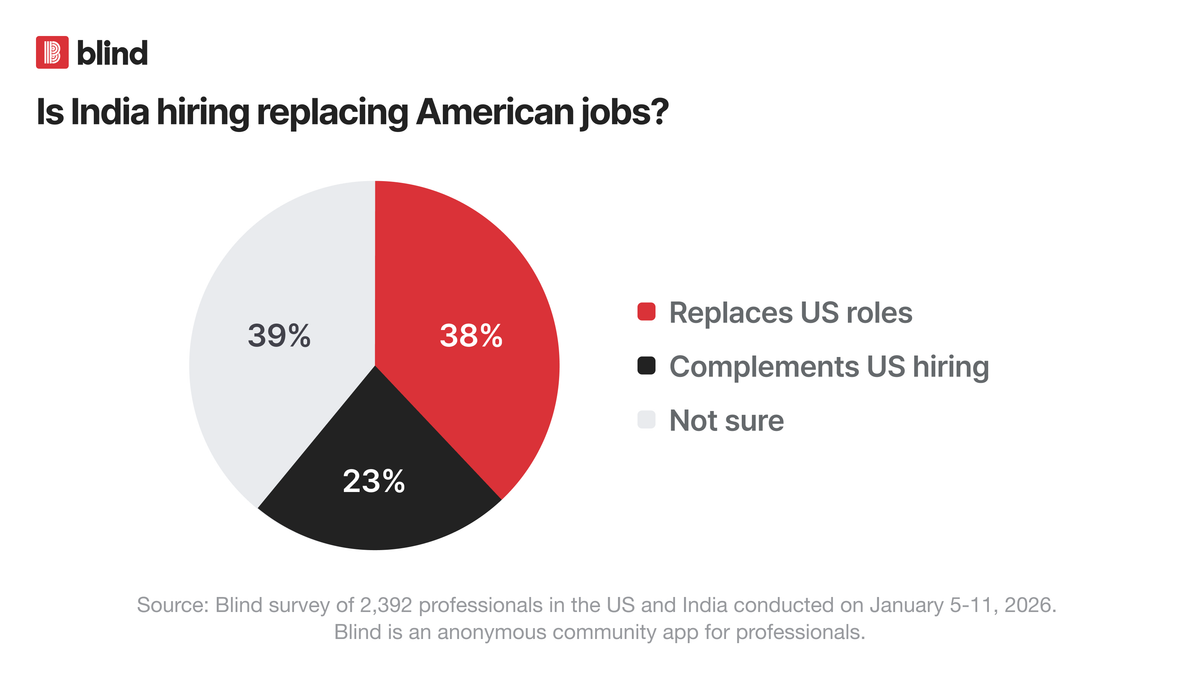
The shift is not merely additive. When asked how increased hiring in India affects U.S. employment, responses were divided. 38% said India hiring is replacing U.S.-based roles, while 23% said it complements U.S. hiring, suggesting that offshoring is increasingly viewed as a substitute rather than a supplement by a significant portion of the workforce.
Respondents also pointed to U.S. visa policy as a contributing factor. 28% said recent H-1B visa restrictions have pushed their companies to increase hiring in India, while 25% said the changes had no material impact on hiring strategy. Only 4% said the restrictions led to increased hiring in the U.S.
Taken together, the findings point to India’s growing role as a functional alternative to the U.S. hiring market. Rather than relying on U.S.-based expansion, many companies appear to be redirecting growth to India, signaling a structural shift in global workforce planning.
Overall, 52% of respondents said their companies are planning to increase hiring in India next year, including 34% who expect a significant increase and 18% who anticipate a moderate rise. Only 13% said hiring in India is expected to decrease, while 18% said plans have not been clearly communicated internally.
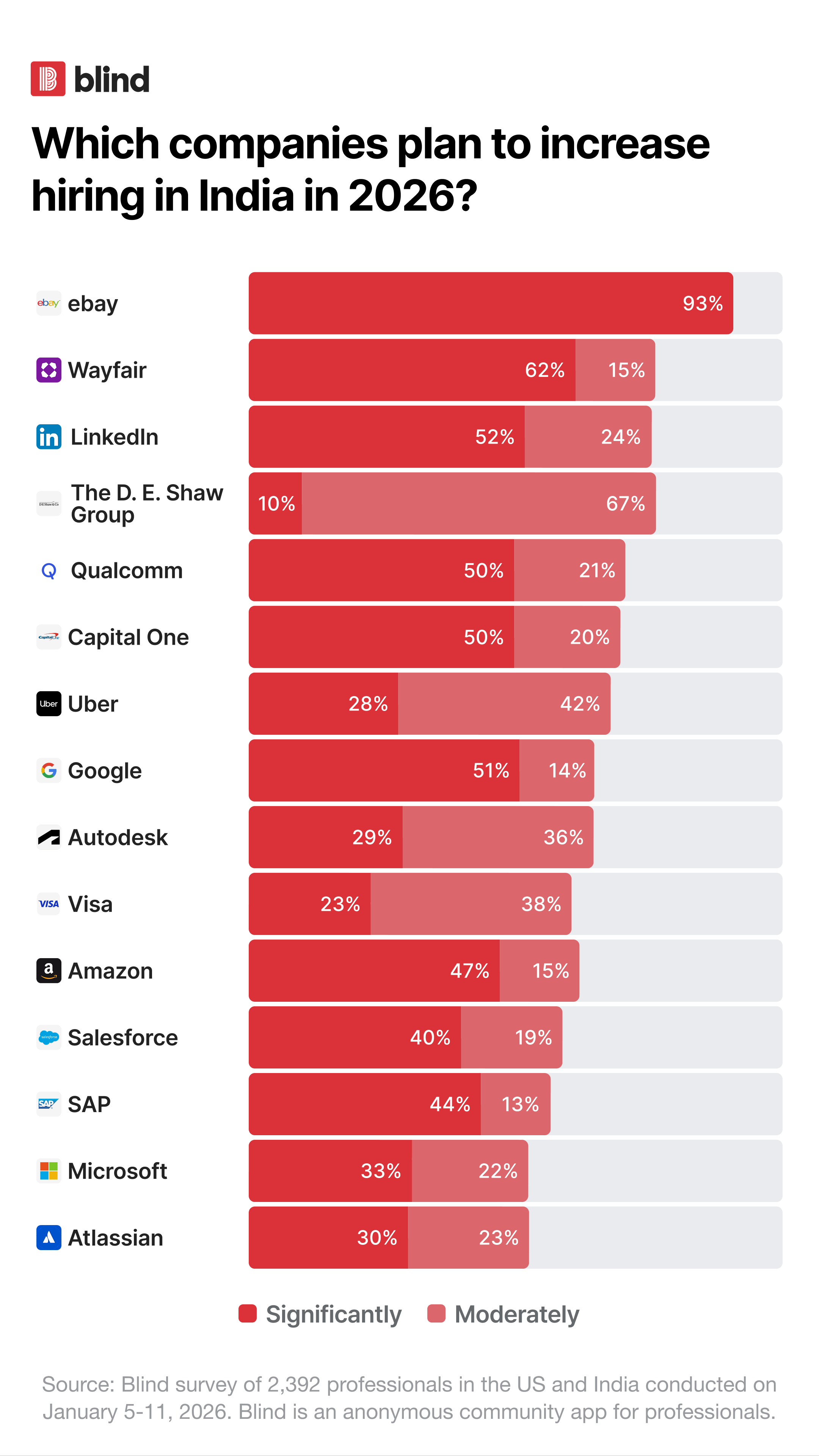
Among employees at global companies such as eBay, Wayfair, LinkedIn, The D. E. Shaw Group, Qualcomm, Capital One, Uber, Google, Autodesk, Visa, Amazon, Salesforce, SAP, Microsoft, and Atlassian, up to 93% reported that their companies are planning to expand hiring in India.
In terms of how companies are expanding in India, 25% said their employers are scaling up existing India teams, while about 20% reported the creation of new roles in India and another 20% said specific projects or functions are being moved there.
Alongside these shifts, some professionals noted that layoffs often framed as AI-driven efficiency moves are, in practice, closely tied to offshoring decisions. As one Amazon employee put it, “Many organizations rushing to cut staff in the name of AI efficiency are expected to quietly rehire those roles—often offshore or at a lower salary.”
Others also shared firsthand accounts that illustrate how offshoring decisions are playing out on the ground. A Meta employee wrote, “If you need top AI talent, you get that in the valley for unspeakable cost… Result, solid but mid jobs are moving to India.” An Amazon professional said “1/3 of my team(only ICs, not mgrs) was laid off recently and they opened the same no of positions in India”, highlighting how companies are reallocating roles across geographies.
Methodology
Blind surveyed 2,392 verified professionals based in the U.S. and India on its platform between January 5 and January 11, 2026 to examine global companies’ offshoring strategies for 2026 and employee sentiment around them. Respondents were requested to answer following questions:
- Is your company increasing hiring in India in 2026?
- Yes, significantly (34%)
- Yes, moderately (18%)
- No change (18%)
- Decreasing (13%)
- Unsure (17%)
- Does India hiring replace or complement U.S. hiring?
- Replaces U.S. roles (38%)
- Complements U.S. hiring (23%)
- Not sure (39%)
- How have H-1B restrictions affected your company's hiring strategy?
- Increased India hiring (28%)
- No impact (25%)
- Increased U.S. hiring (4%)
- Not sure (43%)
- How is your company expanding India?
- Creating new roles in India (20%)
- Expanding India teams (25%)
- Moving specific projects/functions to India (20%)
- Unsure or N/A (35%)
About Blind
Founded in Silicon Valley in 2013, Blind is a verified workplace community platform with the mission of “building sustainable workplace cultures through employee voices.” Over 80% of employees at Meta and Uber use the platform in the U.S., and it has been recognized by TIME as one of the 100 most influential companies in the world. Blind expanded into India earlier this year, where more than half of tech and finance professionals are active users.