Superhuman CTO Conrad Irwin on What It’s Really Like As a Founder
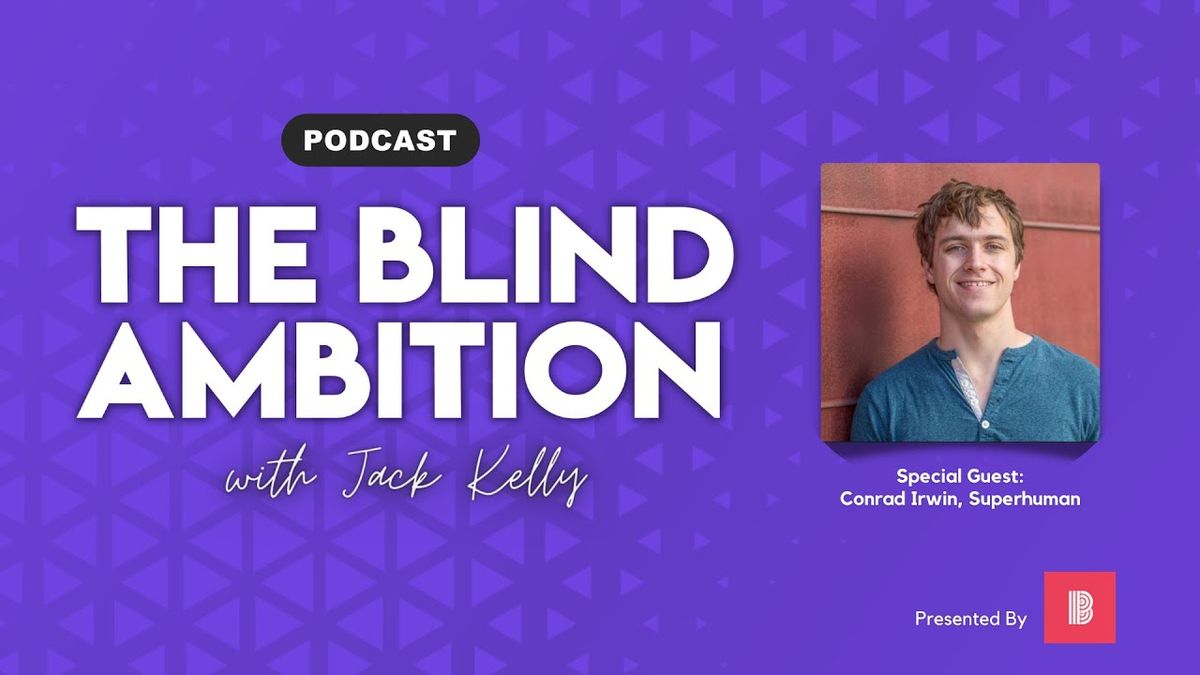
“The Blind Ambition with Jack Kelly” provides a candid look into the top tech companies. Go behind the scenes with tech and workplace leaders and explore engineering and work culture, what it takes to land a role at these companies, and how to build, scale and succeed as an engineer or technologist.
Conrad Irwin is the co-founder and chief technology officer at Superhuman. Superhuman helps people control their email inbox with scheduled messages, follow-up reminders and automated workflows.
Below are some highlights of the podcast featuring Conrad. Listen to “The Blind Ambition with Jack Kelly” above or on your favorite podcast app.
The value of open-source projects
One of the things that’s amazing about open source is [that] you’re usually building a thing for yourself, and so you get this super tight feedback loop… and you keep iterating. That’s the best way of practicing.
I think—particularly as a young engineer—figuring out how to do the engineering and the programming piece, that open source is super helpful…
Then, secondly, and this is again, after moving to San Francisco… I went from having this small online community to—because everyone’s here—being able to stretch that out into a community of people I actually knew. It both helped me with the programming side… and then also very early relationship-building and finding a group of people to be peers and friends with.
The reality of being a startup founder
I’ve jumped in and out, probably every year or so. I go from being a manager to an IC [individual contributor] to a manager again.
In the early days, lots and lots of code, and that was great fun. This year, I have done nothing with the exception of one small fix: I made the development environment work on the end ones, and that was great.
… I don’t think I did a very good job [as a manager] the first time around. So… we ended up… hiring an engineering manager, and that let me step back into more of a technical role.
… There’s a whole new set of skills to learn… [With] programming, the feedback loop can be super tight… [but] with management, the feedback cycle is super long. We’re going to make a change; I’m going to give some feedback, and maybe a few weeks before you can [see] that feedback landed or this change is actually an improvement. So having someone who you can workshop with, again, is a way [to] shorten the feedback cycle.
Being an individual contributor vs. a manager in engineering
It’s a really interesting transition because management is a set of skills. It is a distinct set of skills from programming.
It’s also a set of skills that’s much more subtle, like a lot of them are people skills and awareness skills and things where you can’t really point [to]… Programming is like, look, you just wrote that code; it’s there.
With management skills… it’s… very cerebral and internal… I’m observing these things; what does that mean I have to do next.
The founding story of Superhuman
We want to make every professional get to the end of every day feeling happier and more productive… I used a lot of software that doesn’t make me happier [and that] I would prefer not to, so really making things that are a joy to use is very important to us. Then, the other piece is [being] more productive every day.
… Well, we started the company with this idea of productivity in mind. We went, and we asked 50 or so of our friends, what’s one thing that slows you down at work? Where are you really unproductive?
We got back a pretty resounding set of answers, which was email, email, email, email, email.
… For Superhuman, we probably worked on the codebase for about two years before we got to more than 10 or 15 friends [as] users because we had to build not just a better email client but we had to build an email client to start with. There’s a whole bunch of complexity in there.
… It takes so much longer than you think to get to something valuable, which doesn’t mean that you shouldn’t do it, but it does mean that perseverance and that ability to surround yourself with supportive people who care about the same thing and work on it together. That really helps.
What the job interview at Superhuman is like
We often ask people [when] you made a change and [whether] it had a negative or sub-optimal outcome.
What we’re looking for is both awareness of… [what] you… learn[ed] from that and [how] you make things better.
… We often ask people things like tell me about a time [when] you felt like you were doing the best work of your life. What was exciting about that? What made it all gel?
… [We] really try to tease out people’s values and motivations…
How engineers should write their resumes
We actually look quite carefully at resumes, particularly in cases like this, because there’s a big difference between someone who is acting with that ownership mindset and that productivity mindset versus someone who’s not. It often comes across in the way they write.
One very common thing that, at least for me, is not a good sign is when people have this resume: I worked at “Big Company X.” I did C++ and Git and HTML… Well, that’s not an accomplishment. That’s just a thing.
But if you have someone who’s… responsible for this initiative that caused either a 10% reduction in this or an extra 100,000 users—something where they can tie what they did to an impact that happened, that’s the ownership mindset coming out.
The whiteboard job interview at Superhuman
We ask everyone to write a small piece of software. We give them a prompt. We give them an hour and a half; they get to work on it on their own, and then we check in.
It’s very different when you’re working on a new thing because there [are] no libraries and tools and framing setup. So, one of the other very, very simple things you can do is practice writing a new thing.
- What does it look like to set up a new development environment?
- How do you quickly get stuff done without relying on all of the frameworks that you’re used to at work?
… Make sure that you’re really talking about the ownership and the impact that you had, and make sure that you can actually—within a small amount of time–build something meaningful without the company libraries.
What does a co-founder and CTO do at a startup?
I think the role of the CTO is… to de-risk any of the technological risks, but the role of the co-founder is to be the backstop of last resort. So you can’t really ever say, I don’t want to do that. If it needs to happen, it needs to happen.
Sometimes all kinds of crazy stuff escalate, and it’s like, well, let me figure out how to either reassign this or just get it done. It’s mostly fun, but it’s kind of an odd bag of stuff.
… It’s a lot of learning. Luckily, I kind of enjoy that. I like knowing how things work, so that’s not been a problem for me.