Cutting managers backfires at Intuit, Freshworks, PayPal, and Oracle in India
Nearly half of India-based professionals at major tech firms have witnessed manager cuts, and the damage is already showing up inside teams. A survey of 1,603 India-based professionals by Blind, the anonymous community app for professionals, found that 49% are seeing flattening in some form: 19% through active manager layoffs, another 19% said managers are being moved to individual contributor (IC) roles.
Direct manager layoffs cause more than twice the damage of softer alternatives. Companies flattening through layoffs saw 49% of respondents report negative impacts including productivity loss and communication breakdown, compared to 21% at companies redeploying managers into individual contributor roles.
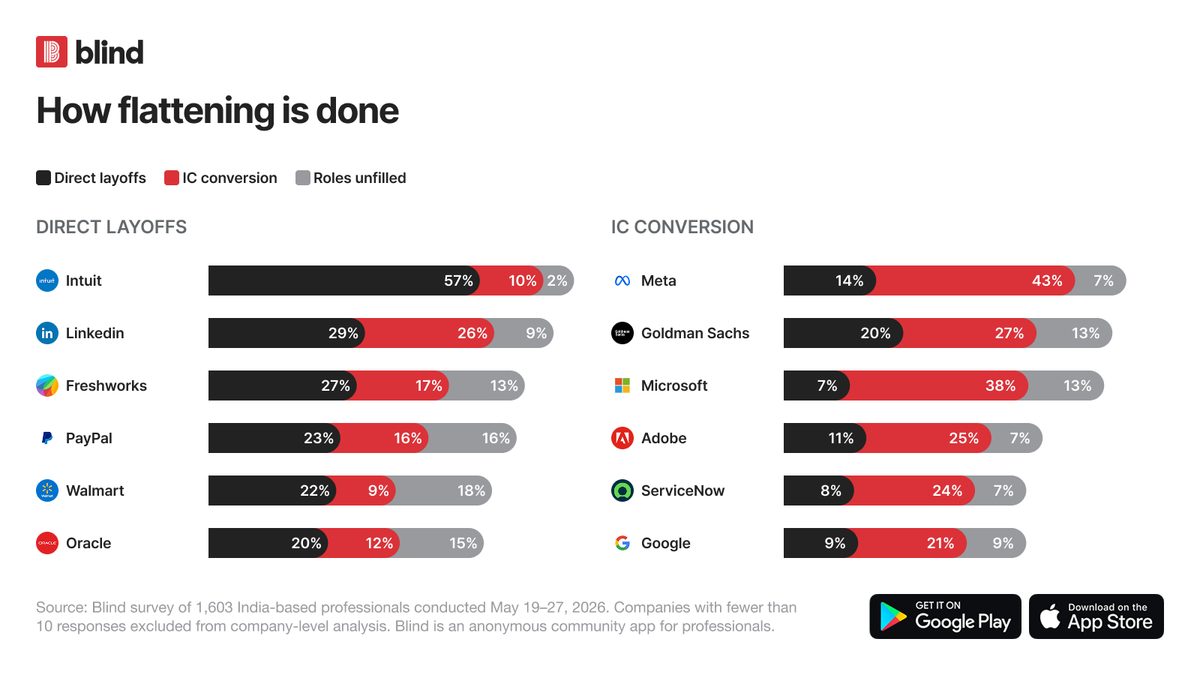
The damage is already showing up at Intuit, Freshworks, PayPal, and Oracle, all of which are pursuing active manager cuts.
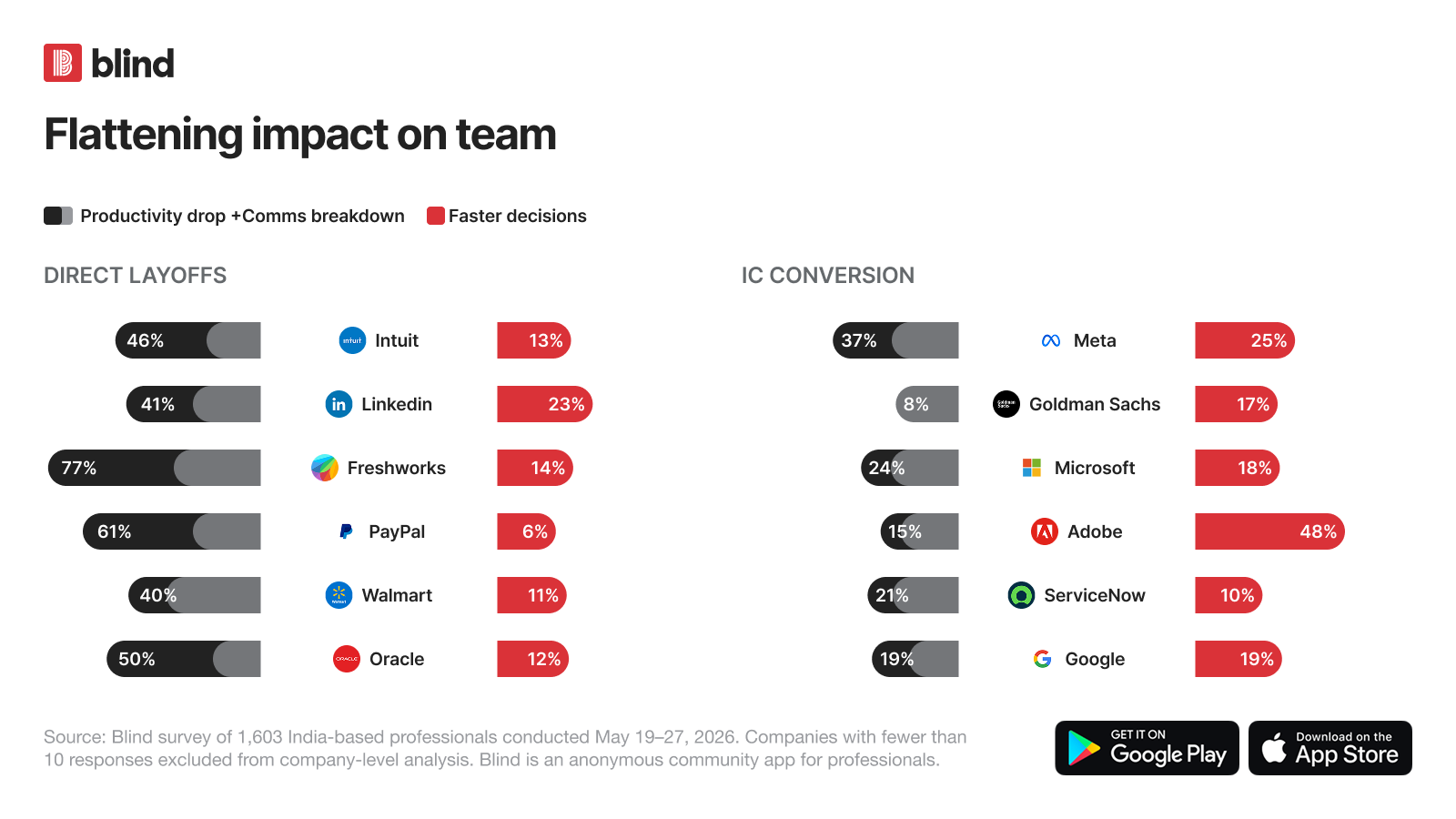
Intuit is the most aggressive flattener: 69% of its managers are being cut, and nearly half of employees are already reporting fallout. On May 20, 2026, CEO Sasan Goodarzi announced a 17% global workforce cut affecting over 3,000 employees, framing it as a move to “reduce complexity, simplify the company’s corporate structure, and deliver better AI products.” But 46% of Intuit respondents already report productivity loss and communication breakdown.
Freshworks reports the highest level of employee-reported negative impact in the survey. 77% of Freshworks respondents reported negative impact, with communication breakdown (32%) nearly matching productivity loss (46%). PayPal (61%) and Oracle (50%) follow closely.
The flattening push isn't accidental. It's being declared openly at the top. On May 5, 2026, Coinbase CEO Brian Armstrong cited the "coordination tax" of excess management layers when announcing a 14% workforce reduction, committing to keep no more than five layers between the CEO/COO and individual contributors. TCS, India's largest IT employer with over 613,000 staff, applied the same logic at a much larger scale: its FY26 cuts of 23,460 are explicitly aimed at middle and senior management, the biggest single-company workforce reduction in Indian IT history. AI handles coordination, so the coordinators go, and India runs the largest operations for both the IT services giants and the GCCs adopting the model.
There is a softer path, and a handful of companies are showing it works. Meta, Goldman Sachs, Adobe, Microsoft, and Google are flattening through IC conversion rather than layoffs, redeploying managers into individual contributor roles.
Adobe leads the survey with 48% of respondents reporting faster decisions and only 15% reporting any negative impact. Goldman Sachs shows zero productivity drop and just 8% reporting any negative impact. Meta, with the highest IC conversion rate in the survey at 43%, saw 25% of respondents report faster decisions. The pattern is clear: when managers are redeployed rather than cut, the speed gains are real and the team damage is minimal.
Methodology
Blind surveyed 1,603 India-based professionals between May 19–May 27, 2026, on middle management flattening. Companies with fewer than 10 responses excluded from company-level analysis. Response breakdowns by question are as follows:
- What's happening to middle management at your company?
- Managers are laid off directly (19%)
- Managers moved to IC roles (19%)
- Open roles not being refilled (11%)
- No changes (42%)
- Actually adding more managers (9%)
- What's the actual impact on your team?
- Productivity dropped (17%)
- Communication broke down across teams (19%)
- Juniors lost mentorship (11%)
- Faster decision, fewer bottlenecks (14%)
- No noticeable change (39%)
- Compared to 2 years ago, how many management layers are between you and your VP?
- Fewer layers than before (32%)
- Same as before (52%)
- More layers than before (16%)