Future of Work 2026
The first annual Future of Work 2026: Era of Silent Layoffs, AI Restructuring, and Boosted Severance Packages report examines how the relationship between employers and employees is changing in 2026.
The Era of Silent Layoffs, AI Restructuring, and Boosted Severance Packages
Employee sentiment doesn't change when the survey is sent—it changes when the workplace changes. Blind captures those conversations as they happen.
Blind is an anonymous professional community where employees discuss workplace experiences in real time. Unlike engagement surveys, which capture responses to predefined questions at scheduled intervals, Blind reflects the conversations employees choose to have when events occur.
This makes Blind particularly valuable for identifying emerging workplace trends, including:
- Shifts in compensation expectations and workplace culture
- Concerns about AI, career growth, and job security
- Reactions to leadership decisions and organizational change
- Changes in employee morale during layoffs and restructuring
By analyzing these conversations over time, Blind provides a continuous view of employee sentiment that complements traditional engagement surveys and public workforce data.
Executive Summary
The first annual Future of Work 2026: Era of Silent Layoffs, AI Restructuring, and Boosted Severance Packages report examines how the relationship between employers and employees is changing in 2026. Based on six months of discussions on Blind, the anonymous workplace community, the report finds that workforce reductions have not disappeared, they have evolved.
Rather than conducting highly publicized mass layoffs, companies are increasingly relying on "silent layoffs": performance management programs, voluntary resignation packages, hiring freezes, reduced backfills, and AI-driven restructuring efforts that gradually reduce headcount without triggering widespread media attention.
At the same time, a new severance arms race has emerged. Several major technology companies now offer significantly more generous exit packages than they did during previous layoff cycles, creating a paradox where employees report appreciating severance packages while expressing historically low morale and confidence in leadership.
The findings also reveal a growing disconnect between financial performance and employee sentiment. Across multiple companies, stock prices and compensation remain relatively strong while morale continues to deteriorate. AI adoption appears to be accelerating this trend, with employees embracing AI tools while simultaneously fearing that those same tools may reduce future hiring and eliminate jobs.
Key Findings at a Glance
- U.S. employers reported 6.95 million layoffs and discharges during the first half of 2026.
- Technology companies announced layoffs affecting nearly 155,000 workers across 407 companies.
- Employees increasingly describe workforce reductions as "silent layoffs" rather than traditional mass layoffs.
- Generous severance packages can improve sentiment toward layoffs, but do not restore trust in leadership.
- Compensation remains a major retention factor, yet morale continues to decline across much of the technology sector.
- AI adoption is accelerating while concerns about long-term job security remain widespread.
1. The Rise of Silent Layoffs
The dominant workforce story of 2026 is not mass layoffs—it is the normalization of quieter, less visible workforce reductions.
Employees across major technology companies describe a shift away from large-scale reduction-in-force announcements toward a combination of:
- Performance Improvement Plans (PIPs)
- Voluntary resignation programs (VRPs)
- Hiring freezes
- Backfill reductions
- Team consolidations
- AI-driven efficiency initiatives
These mechanisms reduce labor costs while minimizing public scrutiny and severance obligations.
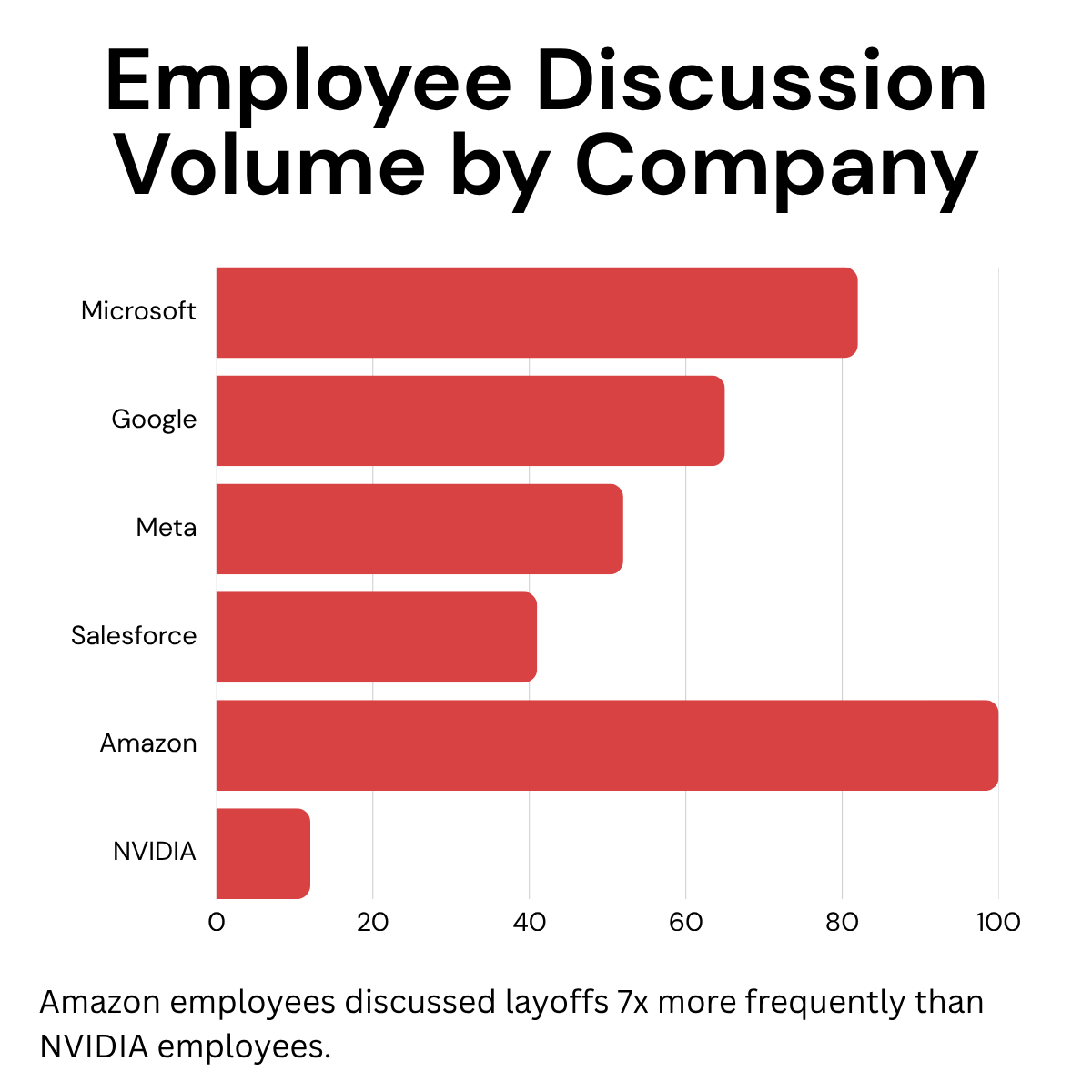
Company Patterns
Microsoft: The Slow Squeeze
Microsoft employees described a gradual restructuring process characterized by increasing performance-management discussions, voluntary resignation offers, and reduced backfills.
Discussion patterns suggest a progression from fear and uncertainty to resignation and cynicism. Employees increasingly viewed workforce reductions as part of a broader structural shift rather than isolated events.
Key concerns included:
- PIP usage
- VRP competitiveness
- Elimination of replacement hiring
- AI-driven productivity expectations
Meta: Shock and Cultural Loss
Meta discussions reflected sudden workforce reductions that generated intense emotional reactions.
Employee sentiment evolved from individual job insecurity to broader concerns about company culture and increasing workloads among remaining employees.
Google: Layoffs by Another Name
Many Google employees perceived performance-based exits and organizational restructuring as a form of indirect workforce reduction.
Discussion themes centered on trust, fairness, and concerns that formal layoffs were being replaced by performance-management mechanisms.
Amazon: Chronic Resignation
Amazon generated the highest layoff-related discussion volume among analyzed companies.
Employees increasingly viewed layoffs as a recurring feature of company operations, resulting in discussion fatigue and declining engagement over time.
Salesforce: Continuous Restructuring
Unlike companies experiencing distinct layoff events, Salesforce employees described a rolling restructuring environment characterized by ongoing uncertainty.
NVIDIA: Anxiety Without Layoffs
NVIDIA discussions differed significantly. Workforce reduction concerns were largely speculative, focusing on future cultural changes and management practices rather than active layoffs.
2. Measuring Employee Response to Layoffs
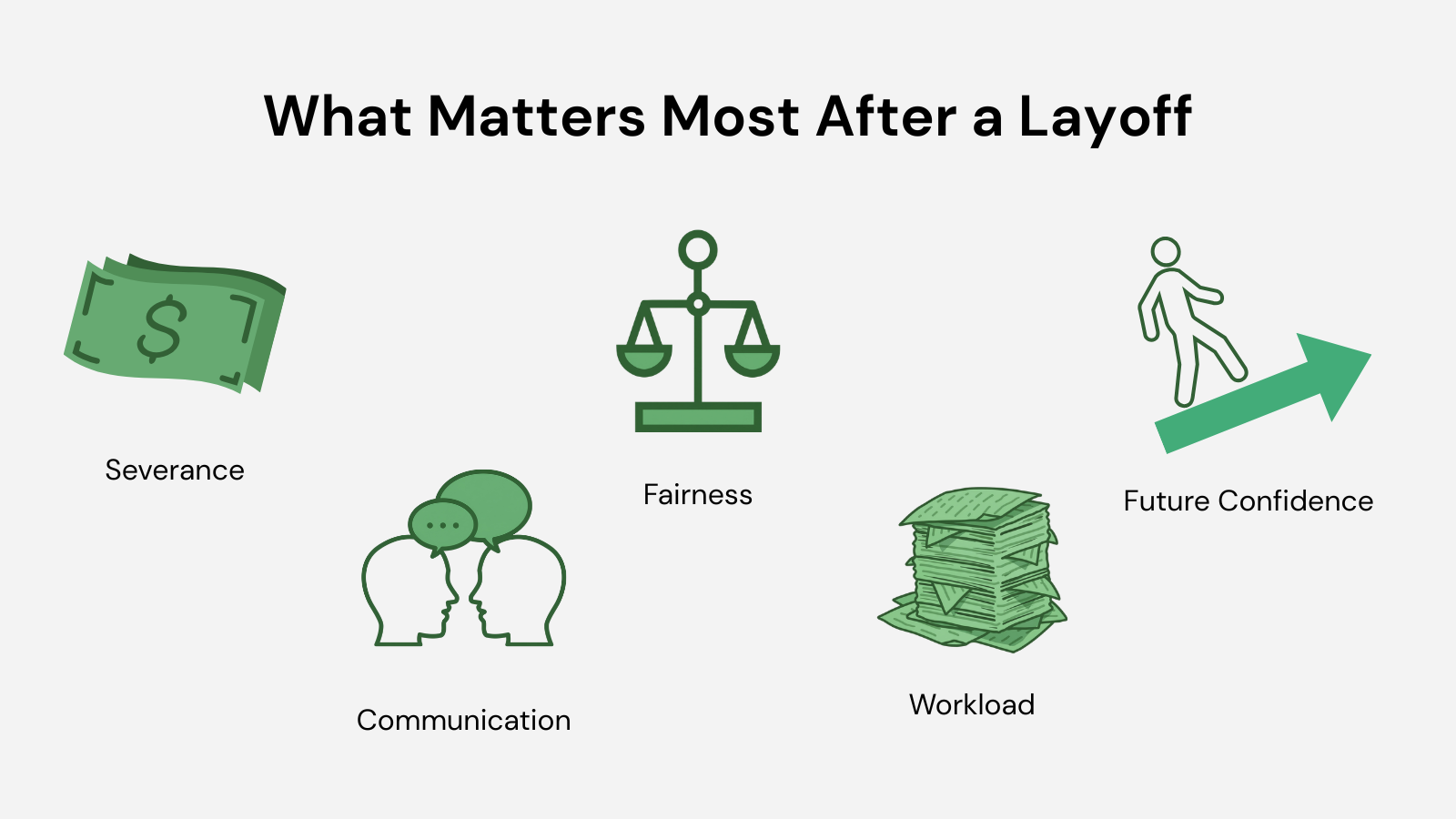
While severance packages often dominate headlines, employee discussions on Blind suggest that compensation is only one piece of the equation. How a company communicates layoffs, supports departing employees, and treats those who remain can have an even greater influence on morale and trust.
Employees consistently evaluate layoffs based on five factors:
- Fairness of the severance package – Employees compare benefits across companies, viewing generous severance as a signal of respect and appreciation.
- Leadership transparency – Honest, timely communication and clear explanations for workforce reductions are closely tied to employee trust.
- Impact on remaining employees – Increased workloads, reduced career opportunities, and uncertainty about future layoffs often have a greater effect on morale than the layoff event itself.
- Perceived fairness of the process – Employees respond more positively when layoffs are viewed as transparent and consistent, rather than arbitrary or performance-driven.
- Confidence in the future – Workers are more likely to remain engaged when leadership provides a credible vision for the company's direction after layoffs.
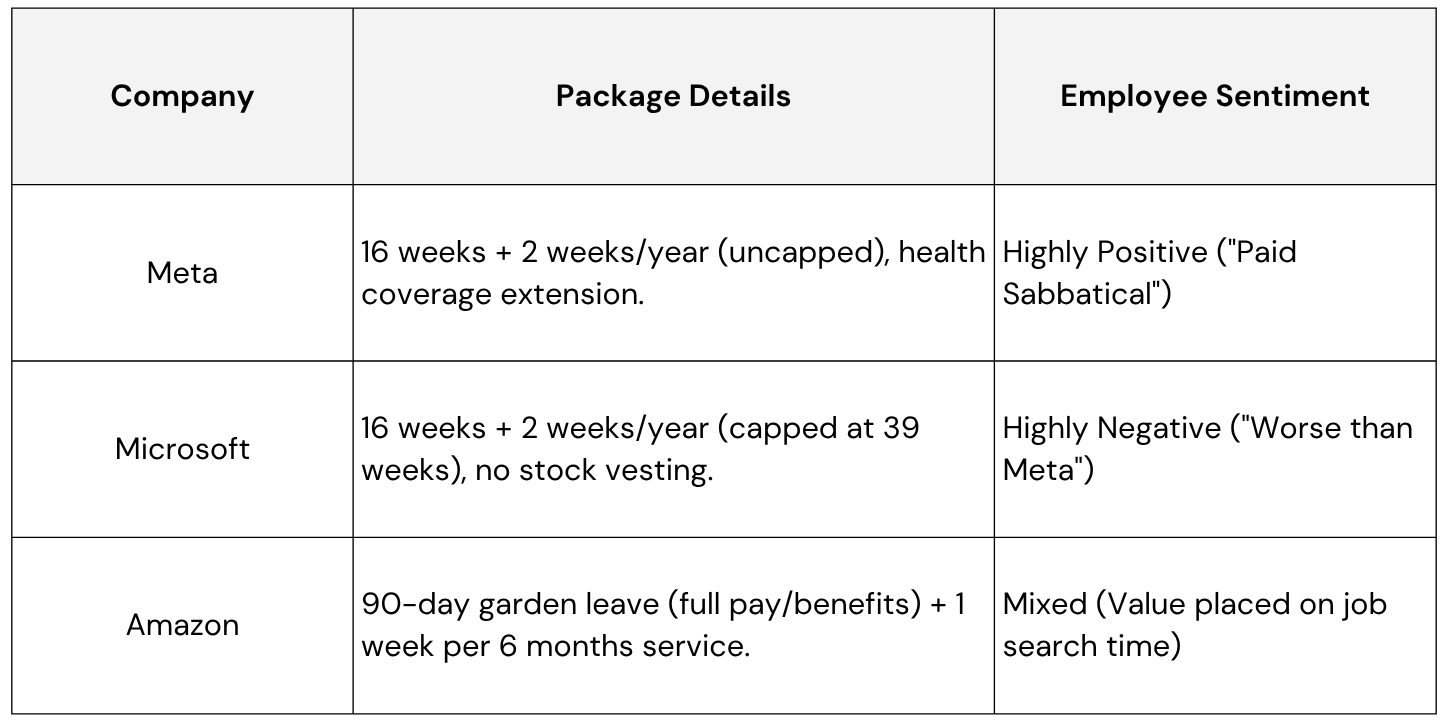
The following company summaries illustrate how these factors influenced employee sentiment across some of the largest technology employers during the first half of 2026.
Meta: Setting the Benchmark for Severance
Meta employees overwhelmingly viewed the company's severance package as one of the strongest in the technology industry. The package included 16 weeks of base pay, an additional two weeks per year of service without a cap, and extended healthcare coverage.
Many employees described the package as generous enough to soften the emotional impact of the layoffs, with several referring to it as a "paid sabbatical." While the layoffs themselves remained difficult, the company's approach to severance was frequently cited as an example of treating departing employees with dignity.
What employees responded positively to:
- Recognition of employee contributions through tenure-based benefits
- Favorable equity treatment
- Extended healthcare coverage
- Generous financial support
Microsoft: Similar Benefits, Different Perception
Microsoft's severance package also included 16 weeks of pay with additional tenure-based benefits, but employee discussions were notably less positive.
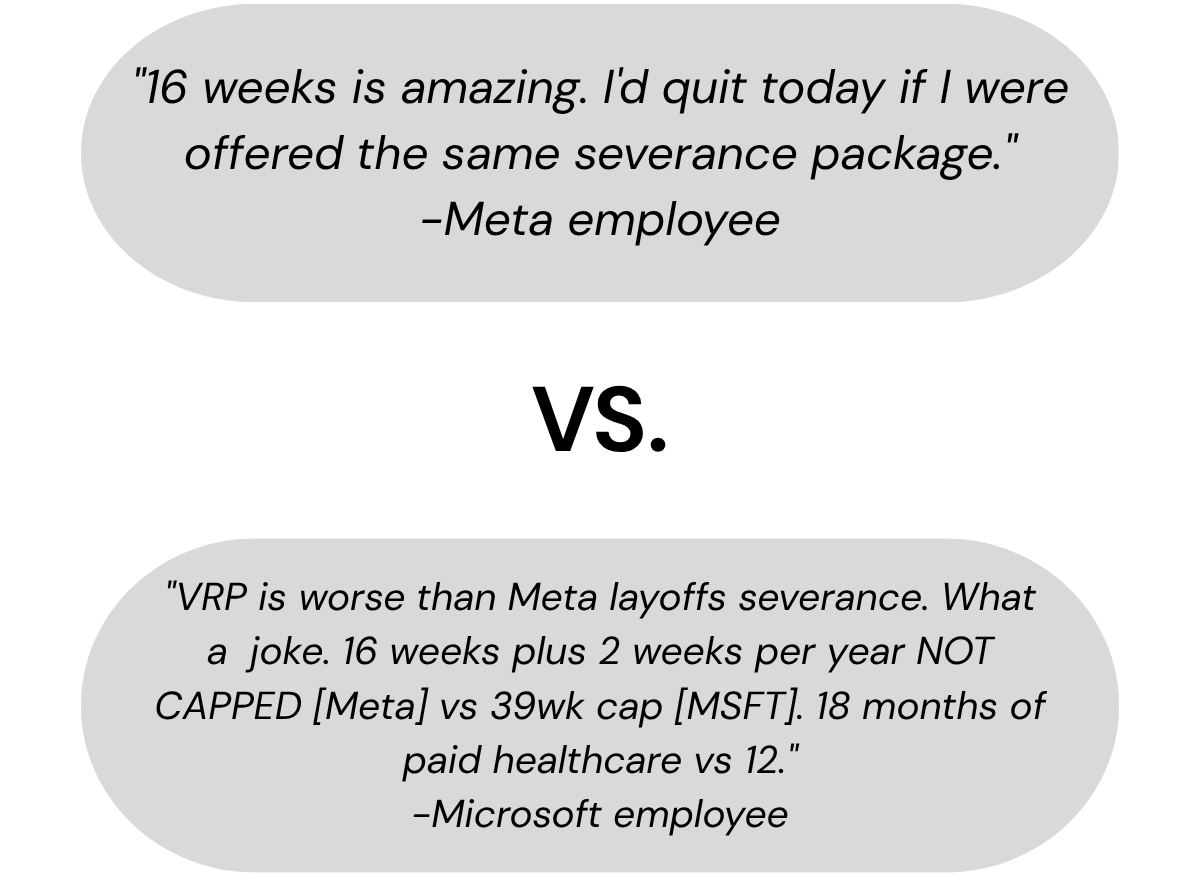
Rather than evaluating the package in isolation, employees frequently compared it directly to Meta's offering. Caps on tenure-based payments, less favorable healthcare provisions, and differences in equity treatment contributed to a perception that Microsoft had fallen behind its peers.
The discussions illustrate an important finding: employees judge severance packages comparatively, not absolutely. Even relatively generous benefits may be viewed negatively if competing companies are perceived to have treated employees better.
Amazon: Garden Leave Advantage
Amazon's severance package generated mixed reactions but included a unique feature valued by employees: a 90-day garden leave period.
Remaining on payroll while searching for a new position provided continued income, healthcare, and equity vesting, giving employees greater financial stability during their transition.
Employees frequently described the additional time as reducing stress and allowing them to focus on finding the right opportunity rather than accepting the first available role.
*Microsoft offers no equivalent.
What Blind Saw Before Everyone Else: What Separates a "Good" Layoff From a "Bad" One
Across all companies analyzed, one conclusion emerged consistently: employees remember how layoffs are handled as much as that layoffs occurred.
Generous severance packages improve perceptions, but they do not fully restore morale on their own. Leadership transparency, fairness, communication, and confidence in the company's future play equally important roles in shaping how employees judge a company's response to workforce reductions.
3. Compensation vs Morale
One of the strongest themes across companies is the growing disconnect between compensation and morale.
Despite relatively strong compensation packages, employees frequently reported burnout, distrust, and pessimism about the future.
According to a survey run on Blind from June 18-30, 2026, where 619 professionals in the U.S. were surveyed, 70% of people did not receive a raise this year, 26% did receive a raise, and 4% were promised one but have not yet received it. Of the 26% who did receive raises, 29% of those were 1-2% salary bumps. On the other hand, 30% of those who received raises earned greater than 10% of a salary increase.
Microsoft
- Compensation score: 2.88/5.0
- Morale sentiment: 74.9% negative
Employees cited stock declines, reduced refresher values, and concerns about future advancement opportunities. Similarly to the morale sentiment being more negative, the compensation sentiment of Microsoft employees is 83.6% negative.
Meta
- Compensation score: 3.98/5.0
- Morale sentiment: 83.8% negative
Despite strong compensation, employees expressed concerns about leadership decisions, layoffs, and workplace culture.
Google maintained the highest compensation ratings among analyzed companies (4.22/5.0).
However, employees increasingly discussed smaller raises, declining refreshers, and reduced enthusiasm despite continued industry-leading pay.
"Refresher 108K. 8.3% less than the previous year. So, bottom line YoY no raise. Feeling super 'motivated'"
NVIDIA
- Compensation score: 3.69/5.0
- Morale sentiment: 47.4% negative
Long-tenured employees benefited enormously from stock appreciation, while newer employees reported frustration with compensation structures and limited advancement opportunities.
Salesforce
- Compensation score: 3.68/5.0
- Morale sentiment: 81.6% negative
Salesforce demonstrated one of the largest gaps between compensation and morale.
While compensation scores remained respectable, employee sentiment remained overwhelmingly negative.
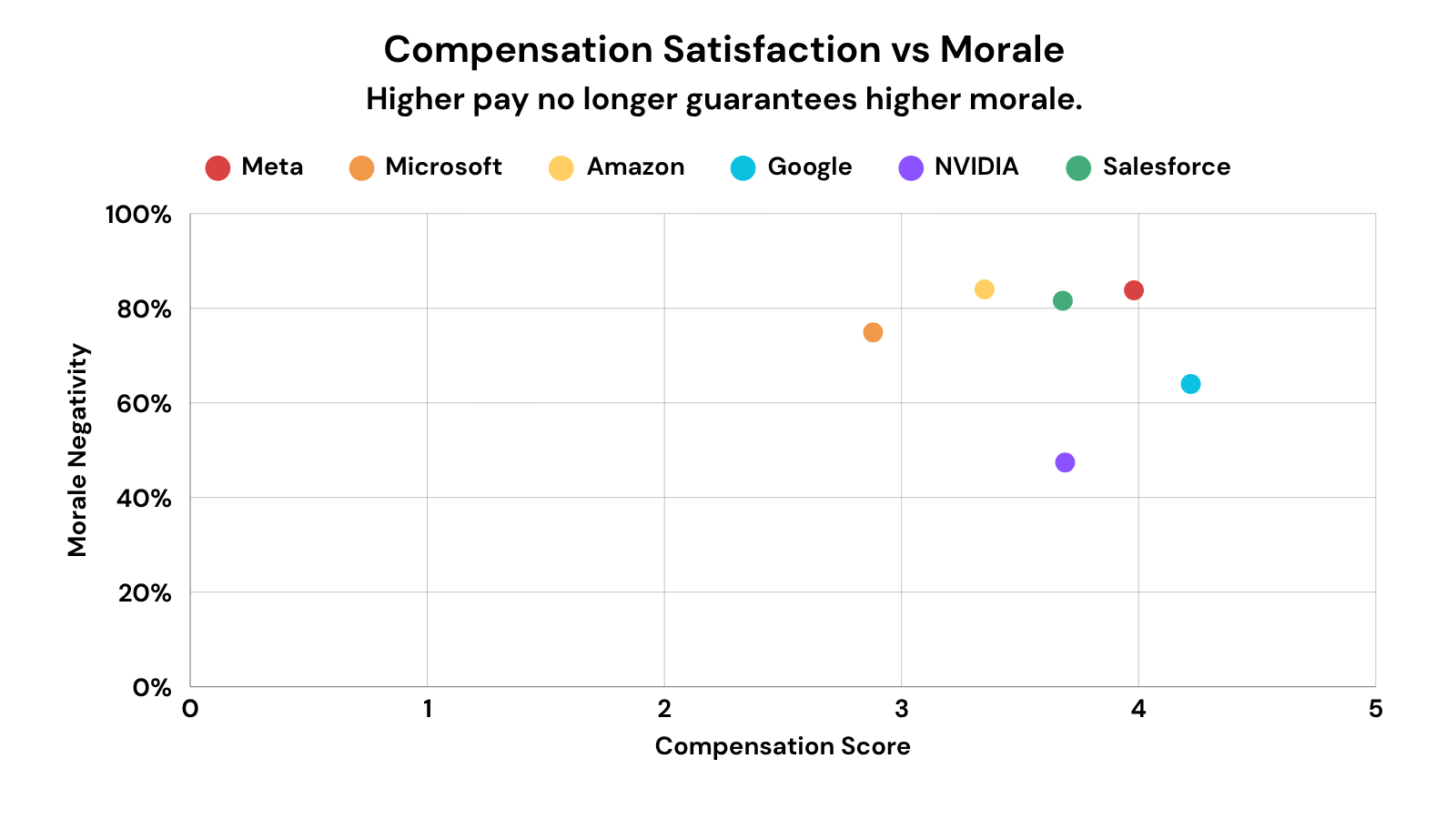
What Blind Saw Before Everyone Else: High Pay Can't Fix Low Morale
High compensation is increasingly viewed as necessary but insufficient. Employees are placing greater emphasis on stability, trust, transparency, and career security.
Morale is determined by the following categories:
- 25% by job stability
- 20% leadership trust
- 15% career growth
- 15% workload
- 10% compensation
- 10% AI confidence
- 5% culture
Not a single compensation-related post expressed positive sentiment from Microsoft employees.
4. When Stock Prices and Employee Sentiment Diverge
For much of the past decade, employee morale in the technology industry tended to move in tandem with company performance. Rising stock prices increased total compensation, strengthened confidence in leadership, and reinforced optimism about career growth.
In 2026, that relationship appears to be breaking down.
Across multiple technology companies, employees report declining trust in leadership, growing job insecurity, and worsening morale regardless of company performance. Whether a stock is rising or falling, workers increasingly evaluate their employers through the lens of layoffs, restructuring, AI-driven workforce changes, and perceived treatment of employees.
Microsoft: The Erosion of Compensation Value
Microsoft employees experienced one of the clearest examples of how stock performance directly impacts workplace sentiment. Following a decline from approximately $520 to $399 since January 2026, employees reported seeing a significant portion of their equity compensation lose value. Many described the decline as effectively erasing two years of stock appreciation, reducing the value of refreshers and leaving some Employee Stock Purchase Plan (ESPP) participants underwater.
The impact extended beyond compensation. Discussions increasingly reflected frustration with leadership decisions, concerns about future earnings potential, and uncertainty surrounding continued workforce reductions.
One employee summarized the sentiment:
"Stock is at 399. That's 2 years of gains gone. My TC is effectively what it was in 2024."
For many employees, declining equity value transformed what might otherwise have been viewed as temporary market volatility into a broader crisis of confidence.
Meta: Strong Financial Performance, Weak Employee Confidence
Meta presents a different but equally significant story. While employees frequently cited strong business performance, revenue growth, and continued market leadership, morale remained deeply negative.
Employees contrasted the current environment with the company's challenges in 2022. During that period, concerns centered on the company's financial future and strategic direction. In 2026, however, employees generally believe the company is financially healthy but increasingly question leadership's priorities.
Discussions frequently referenced layoffs, performance management practices, benefit reductions, increased productivity expectations, and AI-related mandates. Many employees described these initiatives as evidence that leadership is prioritizing efficiency and shareholder value over employee well-being.
As a result, strong business performance has not translated into stronger morale.
The company's stock declined from approximately $715.89 in January 2026 to $563.85, a decline of 21.2%. Yet employee discussions suggest that stock performance itself is no longer the primary driver of sentiment. Instead, perceptions of fairness, trust, and workplace stability increasingly shape how employees evaluate their employer.
What Blind Saw Before Everyone Else: Trust Is Becoming More Important Than Performance
The experiences of Microsoft and Meta point to a broader shift in the employer-employee relationship.
At Microsoft, declining stock performance contributed directly to employee dissatisfaction. At Meta, employees expressed similarly negative sentiment despite strong business fundamentals and continued financial success.
In both cases, concerns about workforce reductions, leadership decisions, AI-driven restructuring, and long-term job security outweighed traditional indicators of company health.
The result is a growing disconnect between financial performance and employee sentiment. In 2026, workers appear increasingly willing to tolerate market volatility but far less willing to tolerate uncertainty, perceived unfairness, or declining trust in leadership.
5. AI and the New Job Security Crisis
Artificial intelligence has become the defining workplace issue of 2026. Across companies, employees increasingly view AI as both an opportunity and a threat: a tool that improves productivity while simultaneously raising concerns about job security, hiring, and long-term career growth.
The dominant fear is not immediate replacement. Instead, employees worry that AI will enable companies to operate with smaller teams, reduce future hiring, and justify ongoing workforce reductions.
Microsoft:
- Over 1 in 5 posts (21.6%) from Microsoft employees express fear of layoffs, making it the single most prevalent topic by a wide margin. It peaked at 30.8% in February 2026, coinciding with confirmed RIFs on 2/2/2026 and rumors of ~17K planned layoffs.
- Posts about AI Augmenting Work surged to 21.8% in March with the Copilot Cowork announcement, showing genuine employee interest in AI tools. However, this dropped sharply to 5.6% by June.
- Leadership pushes AI productivity metrics as a performance indicator, while employees interpret this as a precursor to headcount reduction. One manager reported being handed an AI device and told to "find a way to use it to reduce headcount."
- Specific roles feel most threatened: PMs, marketing engineers, and CSAMs are explicitly mentioned as roles at risk of AI displacement or restructuring.
- Reviews mentioning AI show slightly lower overall scores (3.33 vs 3.41) and notably lower work-life balance scores (3.47 vs 3.70) compared to all reviews in the same period.
Google:
- Over 26.8% of posts by Google employees express fear of layoffs, peaking at 38.2% in February 2026. However, much of this is triggered by external industry news (Amazon's 16K layoffs, Meta's stock award cuts) rather than confirmed Google-specific events.
- Google employees appear to view AI more as a tool than a threat, a 3:1 ratio of augmentation-to-replacement discussions.
Despite layoff fears dominating, only 7.8% of posts are genuinely negative. The community shows resilience through supportive language ("thoughts go out to everyone impacted"), reframing ("this may be a new beginning"), and pragmatic tool adoption discussions.
Only 2.5% of posts discuss reduced hiring, but they receive the highest average engagement of any theme, indicating this is a sensitive topic that employees strongly relate to when raised.
Amazon:
- Senior engineers worry AI augmentation is producing lower-quality work while appearing productive, creating a "de-slop" burden.
- Bezos says AI "elevates" workers; employees see 30,000 colleagues laid off. This disconnect fuels cynicism, especially as the company invested $200 billion on AI.
- Many posts reflect employees in "survival mode," not innovating, just trying to avoid the next layoff round.
What Blind Saw Before Everyone Else: Employees Fear Fewer Jobs, Not Immediate Replacement
Across Microsoft, Google, and Amazon, one pattern emerged consistently: employees are not primarily worried that AI will suddenly eliminate their role.
Instead, they fear a future in which AI enables companies to hire fewer people, reduce backfills, consolidate teams, and continuously increase productivity expectations without corresponding growth in headcount.
In this environment, AI is viewed less as a direct replacement for workers and more as a catalyst for a fundamentally different employment model—one defined by leaner organizations, slower hiring, and heightened competition for opportunities.
The future of work may not be shaped by mass AI-driven displacement. It may be shaped by the gradual disappearance of jobs that are never created in the first place.
Future of Work Index
Layoff Anxiety
- Mentions of layoffs
- Microsoft: 530
- Meta: 2770
- Amazon: 2213
- Google: 276
- NVIDIA: 17
- Salesforce: 175
- Mentions of restructuring
- Microsoft: 74
- Meta: 63
- Amazon: 39
- Google: 30
- NVIDIA: 1
- Salesforce: 10
- Mentions of job security
- Microsoft: 1
- Meta: 4
- Amazon: 5
- Google: 3
- NVIDIA: 2
- Salesforce: 0
AI Anxiety
- Mentions of AI replacement
- Microsoft: 10
- Meta: 18
- Amazon: 6
- Google: 9
- NVIDIA: 2
- Salesforce: 1
- Mentions of hiring freezes
- Microsoft: 42
- Meta: 32
- Amazon: 31
- Google: 6
- NVIDIA: 0
- Salesforce: 10
- Mentions of automation
- Microsoft: 9
- Meta: 20
- Amazon: 21
- Google: 14
- NVIDIA: 1
- Salesforce: 2
Leadership Confidence
- Confidence in CEO
- Microsoft: 28.7%
- Meta: 13.4%
- Amazon: 14.1%
- Google: 52%
- NVIDIA: 39.6%
- Salesforce: 34%
- Confidence in company direction
- Microsoft: 52.6%
- Meta: 25.4%
- Amazon: 30.9%
- Google: 79%
- NVIDIA: 83.3%
- Salesforce: 59%
Methodology & Disclaimer
The findings in this report are based on an analysis of employee discussions on Blind, an anonymous professional community where verified employees share workplace experiences and perspectives. The report examines conversations from January through June 2026, alongside publicly available workforce and labor market data where noted.
The qualitative findings reflect recurring themes, discussion volume, and sentiment expressed by employees at individual companies. Company-specific insights were generated using Blind's internal AI analysis of anonymized discussions and are intended to identify patterns in employee sentiment rather than represent the views of every employee.
Because Blind conversations are anonymous and voluntary, they should be interpreted as indicators of emerging workplace trends and employee perceptions—not as statistically representative surveys of an entire company's workforce.
External figures, including layoff totals, stock performance, and labor market statistics, were sourced from publicly available data and incorporated to provide additional context.
This report is intended to offer employers, business leaders, and journalists a real-time view into how employees are experiencing workplace change during a period of rapid transformation.