It’s Not Just Gen Z: Most Indian Workers Quietly Disengage Before Leaving Toxic Workplaces
Gen Z professionals are often portrayed as quicker to disengage or quit when work turns toxic, with concepts such as “revenge quitting” cited as a trend championed by Gen Z. However, a new survey by Blind suggests that reactions to workplace toxicity are far more similar across generations than commonly assumed.
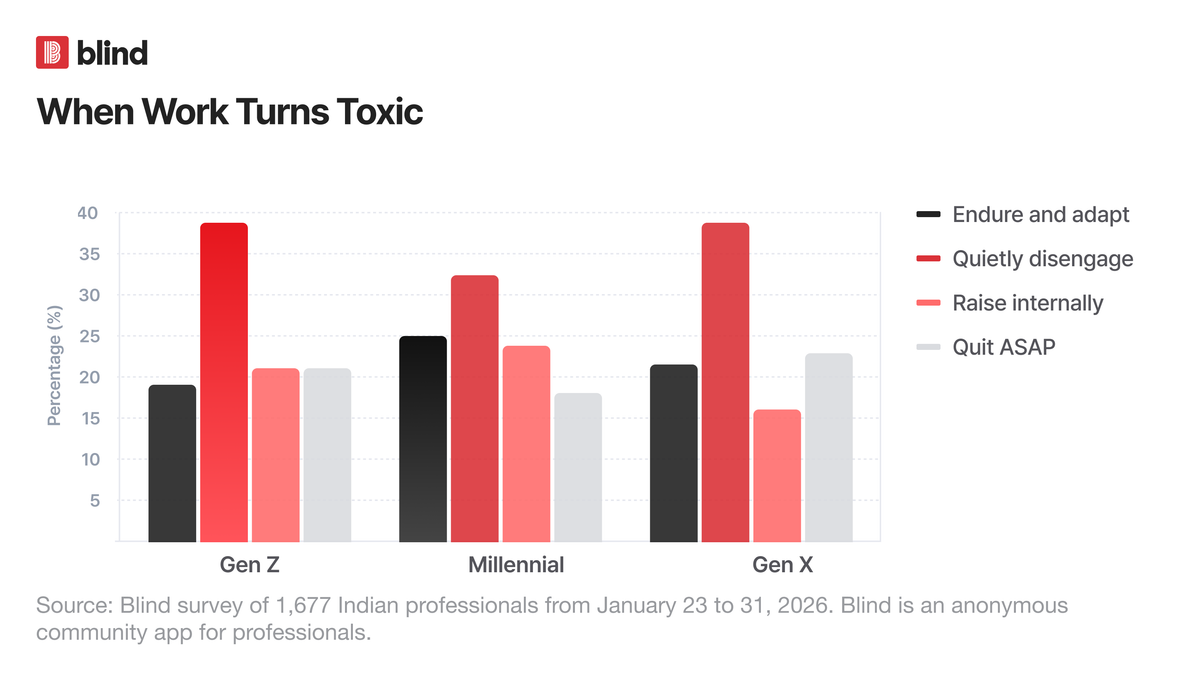
When work starts feeling toxic, quiet disengagement emerged as the most common response across all generations. While Gen Z were the least likely to “endure and adapt” (19%), most respondents across age groups showed a stronger tendency to remain within the organization and look for ways to cope before exiting.
Attitudes toward after-hours messages and late-night work showed little divergence. Across every generation, around half of respondents said these are sometimes necessary but often overused, reinforcing that burnout-related stress is not confined to a single generation. In a separate Blind survey released in April 2025, 72% of Indian professionals reported routinely exceeding the legal 48-hour workweek, and 83% said they had experienced burnout.
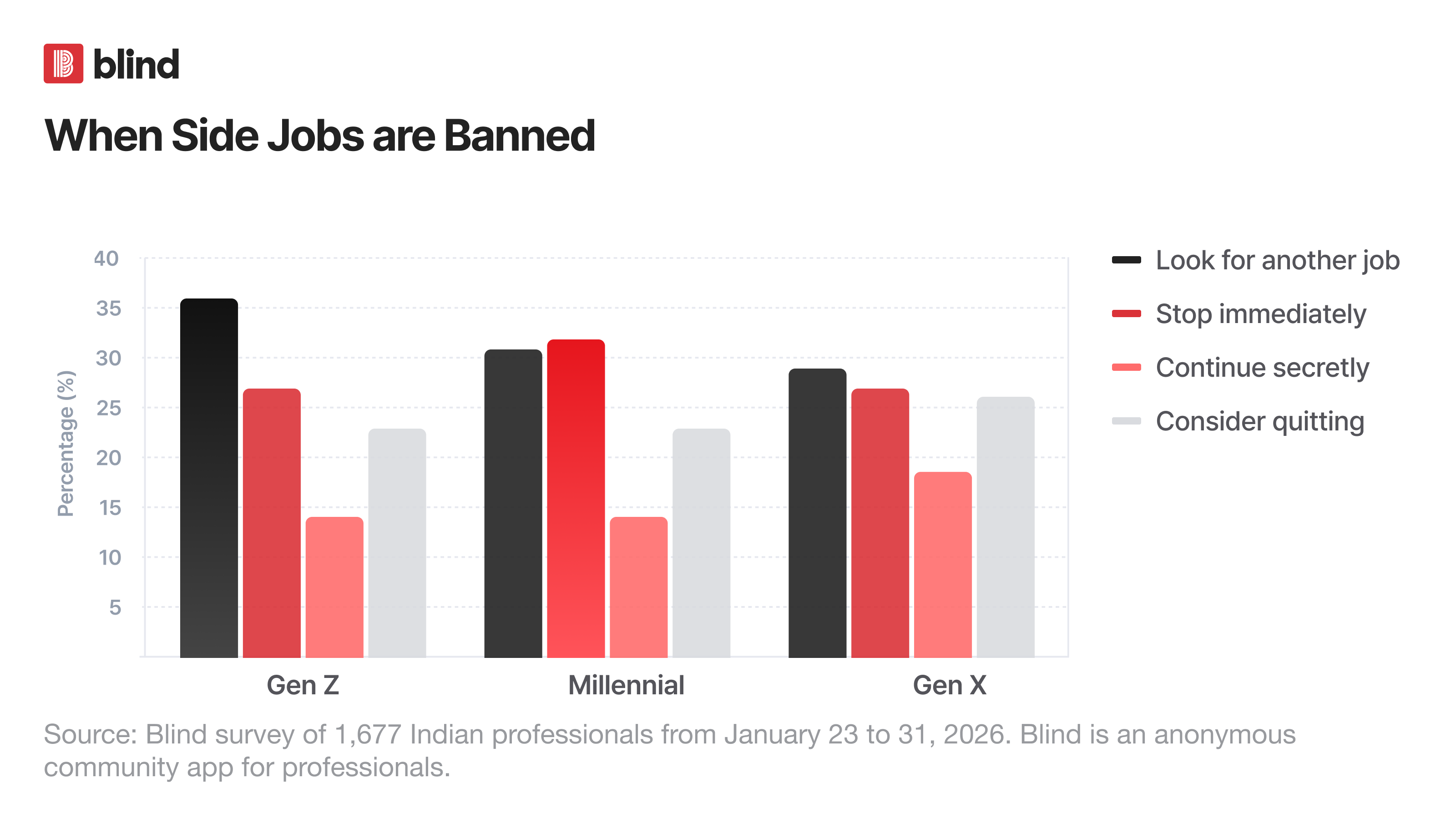
When asked how they would respond if their company banned or discovered a side job, responses were again broadly similar: 36% of Gen Z said they would look for another job, compared with 31% of Millennials and 29% of Gen X. Millennials were more likely than Gen Z and Gen X to say they would stop immediately (32%).
Taken together, these cross-generational behaviors align with economist Albert Hirschman’s Exit, Voice, Loyalty, and Neglect framework, which explains how individuals respond when organizations fail to address internal problems. In this model, quiet quitting corresponds to Neglect, a passive response that often follows repeated, unsuccessful attempts at Voice. Labels such as quiet quitting and revenge quitting may differ, but they point to the same reality: when employees feel stuck in toxic workplaces and unheard, they check out—quietly or loudly—before walking away.
Echoing this sentiment, an Apple employee commented on a Blind post, “As far as Gen X vs Z vs Millennials, it’s all mindset,” underscoring that disengagement is shaped more by organizational response than by age.
Methodology
Blind conducted a survey on its platform between January 23 and January 31, 2026, gathering responses from 1,677 verified professionals based in India across multiple generations. The survey explored how professionals across age groups perceive and respond to workplace toxicity, including after-hours work expectations and restrictions on side income. Respondents were asked the following questions.
- When work starts feeling toxic, what are you most likely to do?
- Try to endure and adapt
- Gen Z (19%), Millennial (25%), Gen X (22%), Boomer or older (21%)
- Raise concerns internally
- Gen Z (21%), Millennial (24%), Gen X (16%), Boomer or older (19%)
- Quietly disengage and do the minimum
- Gen Z (39%), Millennial (33%), Gen X (39%), Boomer or older (29%)
- Quit as soon as possible
- Gen Z (21%), Millennial (18%), Gen X (23%), Boomer or older (31%)
- How do you personally feel about after-hours messages and late-night work?
- Necessary for the job
- Gen Z (11%), Millennial (11%), Gen X (15%), Boomer or older (7%)
- Sometimes necessary, but often overused
- Gen Z (47%), Millennial (51%), Gen X (50%), Boomer or older (47%)
- Unnecessary and frustrating
- Gen Z (19%), Millennial (19%), Gen X (9%), Boomer or older (23%)
- Sign of poor management
- Gen Z (23%), Millennial (19%), Gen X (26%), Boomer or older (23%)
- If you had a side job and your company banned or found out about it, what would you do?
- Stop immediately
- Gen Z (27%), Millennial (32%), Gen X (27%), Boomer or older (39%)
- Continue secretly
- Gen Z (14%), Millennial (14%), Gen X (18%), Boomer or older (11%)
- Look for another job
- Gen Z (36%), Millennial (31%), Gen X (29%), Boomer or older (17%)
- Consider quitting
- Gen Z (23%), Millennial (23%), Gen X (26%), Boomer or older (32%)