Trump’s Immigration Executive Order: How Tech Employees Communicate About H-1B Visa's
At Blind, many of our users are H-1B visa holders. Tech professionals on the app often share H-1B visa news with one another, and have even started their own visa transfer timelines, to help one another gain clarity.
Today, President Trump is expected to sign an executive order that temporarily bars new immigrants on a slate of employment-based visas including the H-1B visa. The restrictions are slated to last until the end of the year. Notably going past October when most of the newly issued H-1Bs are issued.
This seems to contradict S.386, which was introduced in the Senate on 02/07/2019. The bill increased the per-country cap on family-based immigrant visas from 7% of the total number of such visas available that year to 15%. It also removed an offset that reduced the number of visas for individuals from China. The S.386 bill, also known as the “Fairness for High-Skilled Immigrants Act of 2019”, established transition rules for employment-based visas from FY2020-FY2022, by reserving a percentage of EB-2 (workers with advanced degrees or exceptional ability) and EB-3 (skilled and other workers) visas for individuals not from the two countries with the largest number of recipients of such visas.
Immigrants make up an estimated 17% of the overall U.S. workforce. The seemingly insurmountable challenges arising from the pandemic are even trickier for professionals on H-1B status, who have a unique set of requirements tied to their employment. For example, H-1B holders who were laid off due to the coronavirus pandemic have 60 days to either find a new role or return to their home countries. With fewer levels and a tough job market, a Bloomberg piece is calling out these employees “only have bad options”.
Because of this trend, Blind partnered with Saleh and Associates PA back in April, to help professionals get their immigration-related questions answered.
About Saleh: Saleh is a Florida Bar Board Certified immigration lawyer with over 25 years of experience in all areas of U.S. immigration law. He has worked with thousands of individuals and companies to resolve their immigration issues. He has been listed in the Wall Street Journal and other similar publications as one of the best attorneys in Florida.
During the four hour session, he addressed questions like: Are you dealing with immigration issues due to the COVID crisis? Facing a layoff, furlough, reduced work hours, etc.? Are you concerned about falling out of status?
One user used this opportunity to leverage the lawyer and learn some h4 EAD news. The question was: Currently working on 1-year OPT with EAD ending in June this year. My application wasn’t picked in the H-1B lottery this year( it was my last attempt). Based upon your experience, what are your thoughts on Day-1 CPT/Ph.D. route given it’s a grey area? How risky is it for the short and long term?
- Answer: “Yes, I have seen that scenario many many times. It is legal to pursue CPT from Day 1 as long as it authorized by the school, the program of study you are pursuing, and reflected on your I-20.” “With all due respect to *this Blind user, you are legally and factually incorrect. It is not only legally permissible, but done all the time and it works. Please provide the legal basis, including regulations and case law, that supports your blanket assertion.”
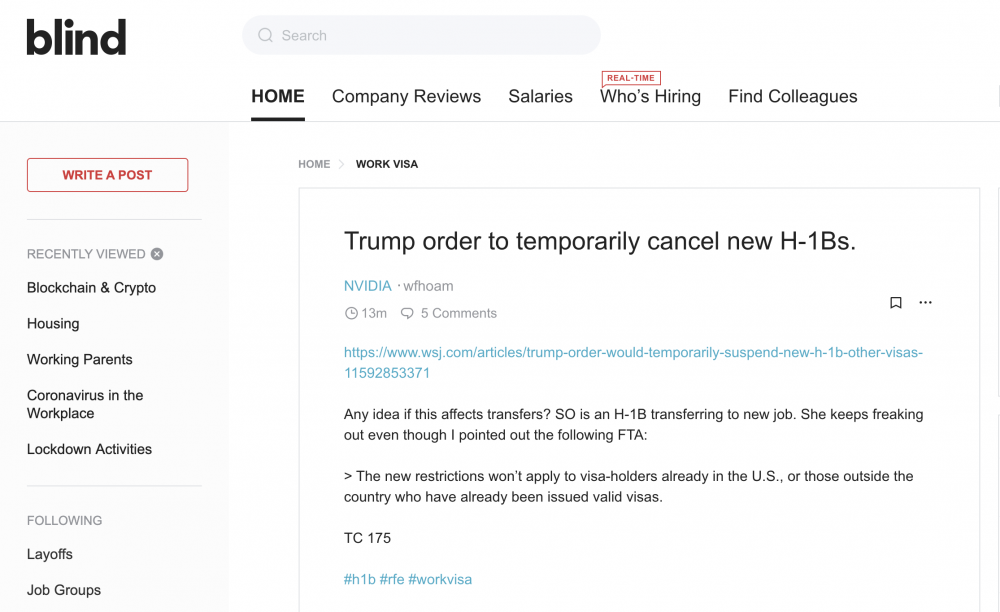
According to the Wall Street Journal, “In addition to the H-1B visa, the temporary ban will apply to new H-2B visas for short-term seasonal workers in landscaping and other nonfarm jobs, J-1 visas for short-term workers including camp counselors and au pairs and L-1 visas for internal company transfers”.
A user at NVIDIA posted the article and asked “Any idea if this affects transfers? *Significant other is an H-1B transferring to a new job. She keeps freaking out even though I pointed out the following FTA:> The new restrictions won’t apply to visa-holders already in the U.S., or those outside the country who have already been issued valid visas.”
Blind will continue to facilitate these conversations and help users navigate their careers during these uncertain and unprecedented times. We will work to provide resources to continue to add color to topics ranging from employment verification letters to any visa related news.