When AI Strategy Moves Faster Than Leadership Understanding
Across industries, executive teams are coming up with plans of action to incorporate AI into their company’s work flows. With the main goal to optimize efficiency and productivity, some teams are missing the point.
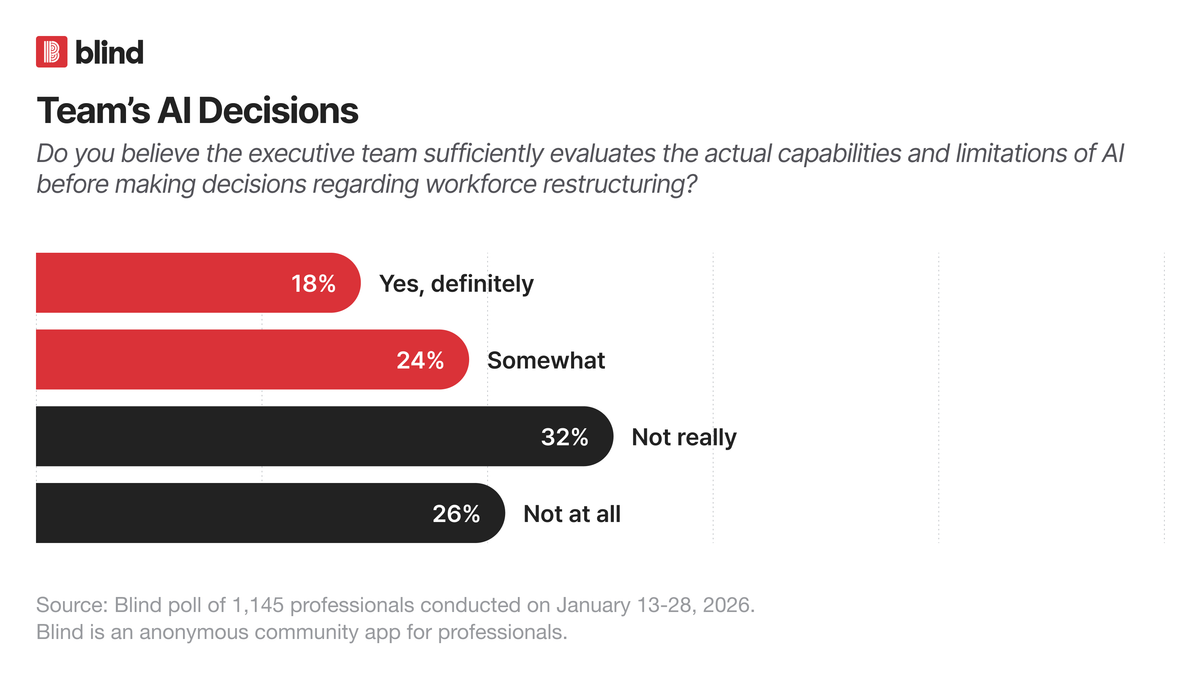
According to a survey of 1,145 verified professionals on Blind, ran from January 13 to January 28, 2026, 24% of executive teams are not sufficiently evaluating the actual capabilities and limitations of AI before making decisions regarding workforce restructuring.
The most common industries that responded to this survey were internet (40%), computer software (21%), and financial services (12%).
56% of respondents said that their company’s executive teams have either only somewhat or not really evaluated the actual capabilities and limitations of AI. Of these responses, 32% came from the internet industry.
When asked about augmentation or replacement, 31% of respondents noted that they believe their executive team is mostly focused on empowerment, but are considering some replacement. 25% believe that their leadership is primarily focused on empowering employees and increasing productivity.
And replacement doesn’t always mean automation.
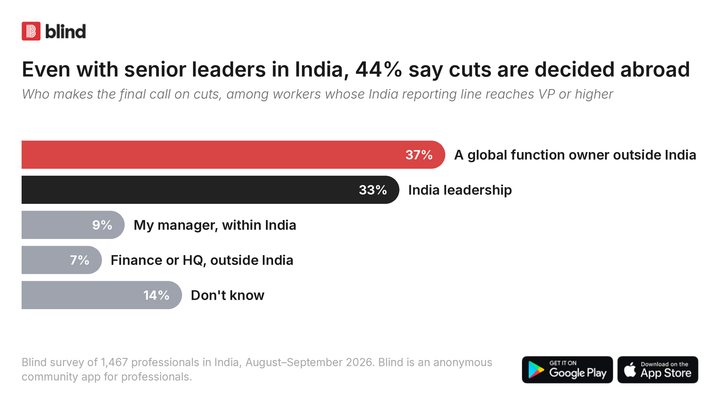
In a separate Blind survey conducted January 5–11, 2026, 38% of jobs in India are reported to be roles that previously belonged to U.S.-based employees. Some professionals noted that layoffs often framed as AI-driven efficiency moves are, in practice, closely tied to offshoring decisions. As one Amazon employee put it:
“Many organizations rushing to cut staff in the name of AI efficiency are expected to quietly rehire those roles—often offshore or at a lower salary.”
When it comes to the impact of AI on teams, 57% of professionals think their leadership teams have no plans in place to reskill or reassign employees whose positions are no longer necessary. What this means is that employers will continue with layoffs as AI replaces members of their workforce, or as they offshore those positions.
Methodology
Blind conducted a survey on its platform from January 13 - 28, 2026, collecting responses from 1,145 verified professionals based in the United States. The survey was composed of three multiple-choice questions, designed to assess the respondents’ point of view on their executive teams’ understanding of AI in the workplace.
- Do you believe the executive team sufficiently evaluates the actual capabilities and limitations of AI before making decisions regarding workforce restructuring?
- Yes, definitely (Decisions are made after thorough technical and strategic review) (18%)
- Somewhat (Decisions follow trends, but with some level of review) (24%)
- Not really (Decisions feel rushed without a deep understanding of the technology) (32%)
- Not at all (Decisions seem blindly driven by the goal of immediate cost reduction) (26%)
- In your view, is the leadership’s AI strategy more focused on "Augmentation" (enhancing employee capabilities) or "Replacement" (substituting employees with AI)?
- Primarily focused on empowering employees and increasing productivity (25%)
- Mostly focused on empowerment, but considers some replacement (31%)
- Mostly focused on job replacement and cost reduction (27%)
- Explicitly aimed at downsizing and replacing the workforce (17%)
- Does the executive team have a practical plan to reassign or reskill employees whose roles are impacted by AI?
- Yes, there is a concrete and systematic plan for reskilling and internal mobility (7%)
- There is a high-level plan, but execution is lacking (19%)
- There is no plan; the company prefers natural attrition or layoffs (57%)
- The prevailing sentiment is that AI adoption equals immediate headcount reduction (17%)