Workers pushed out of the U.S. get rehired cheaper in India. U.S. Big Tech is the real winner
53% see workers returning from the U.S., but 51% say jobs are shrinking, not growing
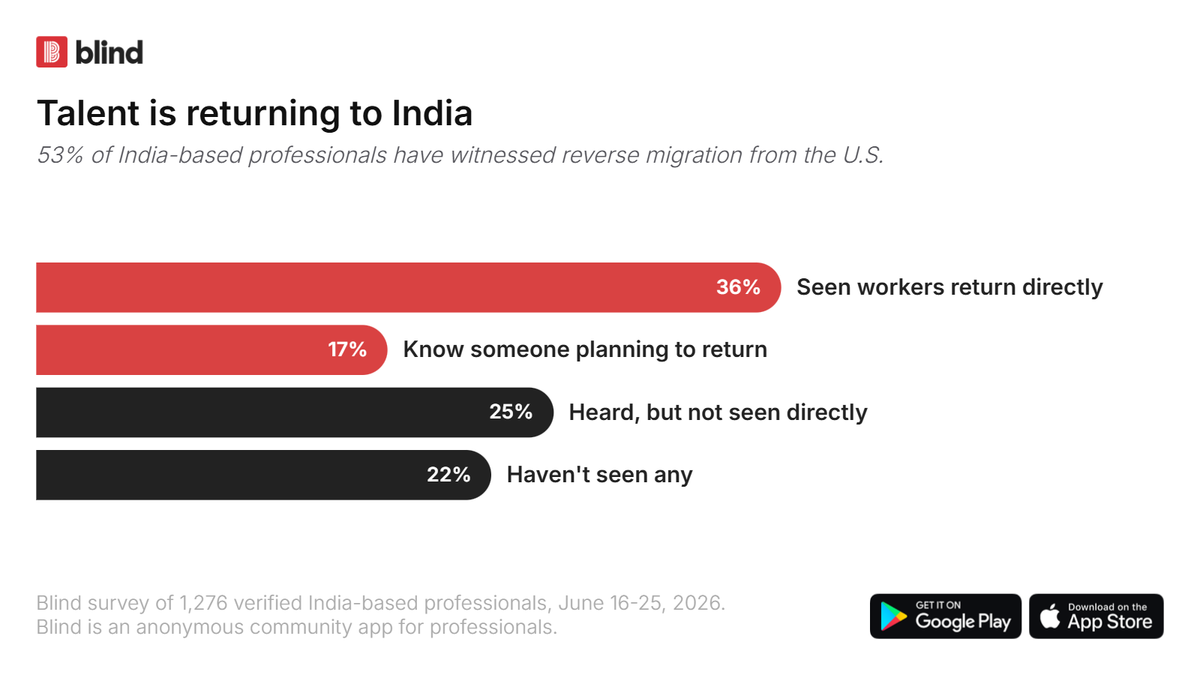
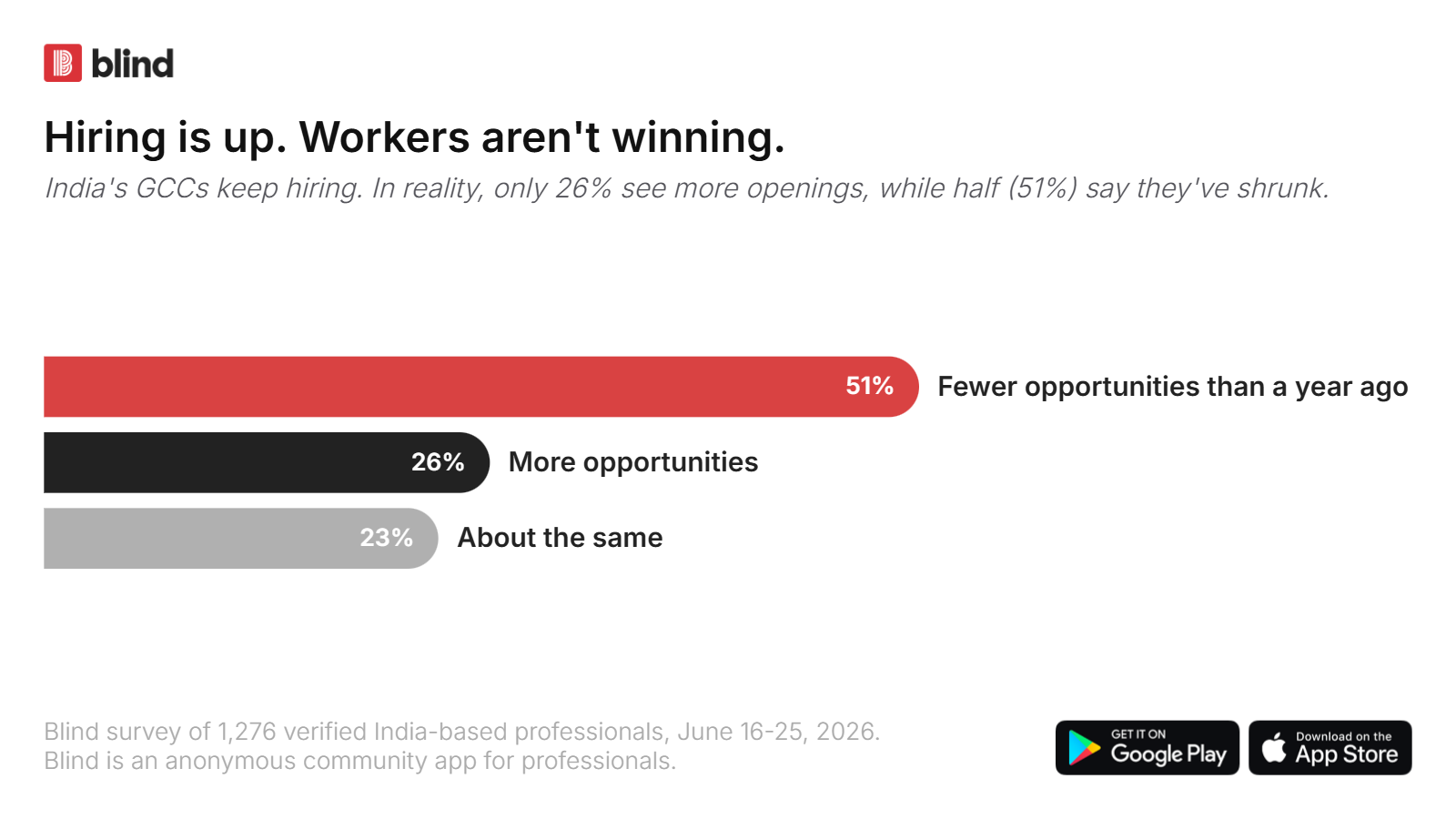
More than half of professionals in India (53%) have witnessed reverse migration, according to a new survey of 1,276 verified professionals by Blind, the anonymous community app for professionals. U.S. visa uncertainties are pushing workers out while India's expanding Global Capability Centers (GCCs) promise a growing pool of jobs back home, yet the opportunity doesn't seem to be there. Only a quarter (26%) say job openings have grown over the past year, while half (51%) say they have actually shrunk.
The winner of this structural shift isn't the returning workers, nor local Indian talent. It's the U.S. Big Tech firms reabsorbing the same engineers into their GCCs.
The return is already well underway. 36% of respondents say colleagues or candidates have already returned, and another 17% know people planning to. The trend is strongest at large consumer tech firms, including 57% of Amazon employees, 58% at Walmart, and 55% at Uber. These are the same companies scaling India GCCs most aggressively, suggesting the return is felt strongest where offshoring is moving fastest.
GCCs are indeed adding jobs in India. But those openings aren't reaching local workers, because U.S. Big Tech is filling them with the same engineers it's letting go in the U.S., the same skill set at a much lower cost. The result is a market that grows on paper but shrinks in practice. Half (51%) of respondents say opportunities have decreased over the past year, even as supply grows. The expansion is real, but on the ground it feels less like a growing market and more like tighter competition for seats already at the table.
And even those who do return work for far less. As one Google professional put it on Blind, “Average pay has gone down in the last 6 months. So you might be looking at a 1/5th pay [of the US].” For employers, that's exactly what makes the math work. Workers trade away pay and benefits for relief from visa risk, and that gap becomes the company's gain.
The pain lands unevenly, and AI is the dividing line. AI and ML engineers are the most shielded, with only 42% saying opportunities shrank. Outside that track, it is worse with over half of Software Engineering (52%), Product (54%), and Data and Analytics (56%) professionals reporting fewer openings than a year ago. Roles close to AI still see demand, while workers in traditional core functions are left competing for a shrinking pool of openings.
The structural shift is already visible in the data, but workers themselves are unsure what to make of it. Negative sentiment (39%) runs at nearly twice the level of positive (21%), yet the largest group, 40%, sits in the middle, undecided whether returning talent will intensify competition or lift the whole market.
Methodology
Blind surveyed 1,276 India-based professionals between June 16–June 25, 2026, on reverse migration from the U.S. and its impact on India's tech job market. Response breakdowns by question are as follows:
- Compared to a year ago, how has the job market in India changed for your role?
- Fewer opportunities than a year ago (51%)
- About the same (23%)
- Many more opportunities (17%)
- Somewhat more opportunities (9%)
- Have you seen people return (or planning to return) from the U.S. to work in India?
- Yes, colleagues or candidates returned (36%)
- Yes, I know people planning to return (17%)
- I've heard about it but not directly (25%)
- No, I haven't seen this (22%)
- How do you think this U.S.-to-India return wave will affect your own career prospects?
- Neutral, no real impact on me (40%)
- Positive, they lift the whole market including my salary prospects (21%)
- Negative, they take roles I would have qualified for (24%)
- Negative, they raise the bar and salary expectations (15%)
- Which best describes your role?
- Software Engineer (59%)
- Product Manager (12%)
- AI / ML Engineer (11%)
- Data / Analytics (5%)
- Business / Operations (5%)
- Designer / Research (4%)
- Finance, Consulting, or Other (4%)